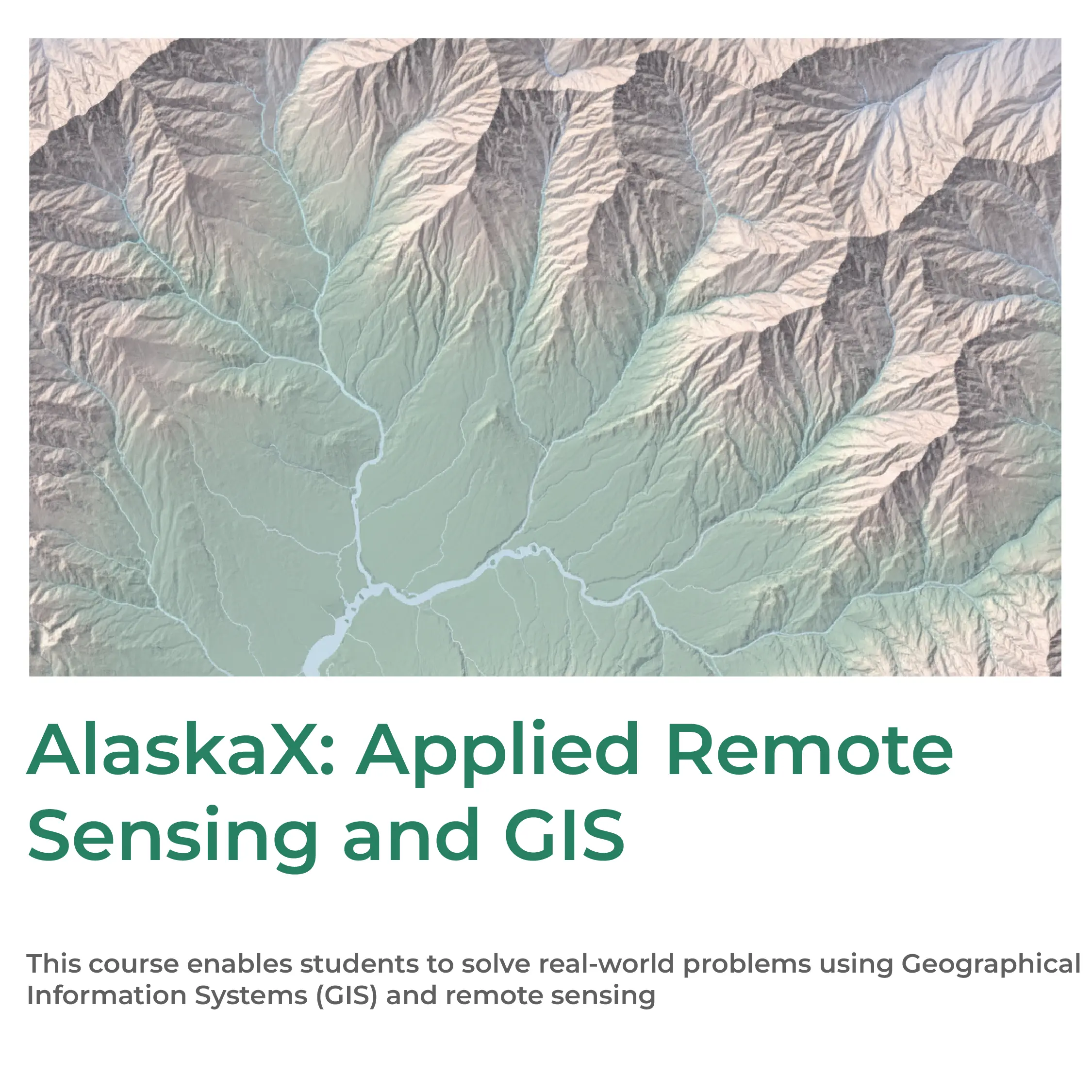
Applied Remote Sensing and GIS is an intermediate-level course designed to help learners apply geospatial technologies to real-world problem-solving. Through a combination of GIS theory and hands-on exercises, students build proficiency in managing vector and raster datasets, working with elevation models, and integrating point-based GNSS data within ArcGIS Pro. The course also develops a strong foundation in understanding geospatial data accuracy—how it is measured, how errors occur, and how they can be mitigated through informed workflows.
Spanning three weeks of self-paced learning, the course covers GIS fundamentals, the applications of elevation data across environmental and engineering domains, and the principles of GNSS acquisition and precision assessment. Learners in the verified track gain practical experience analyzing multispectral imagery, extracting shape and height information, evaluating stereo-derived elevations, and interpreting SAR and hyperspectral datasets. By the end of the course, participants are equipped with applied skills in remote sensing, GIS analysis, and geospatial data validation, preparing them for technical roles in mapping, environmental monitoring, natural resource management, and spatial analytics.



Reviews
There are no reviews yet.