THE DAY ARCHITECTURE STOPPED BEING A PROFESSION
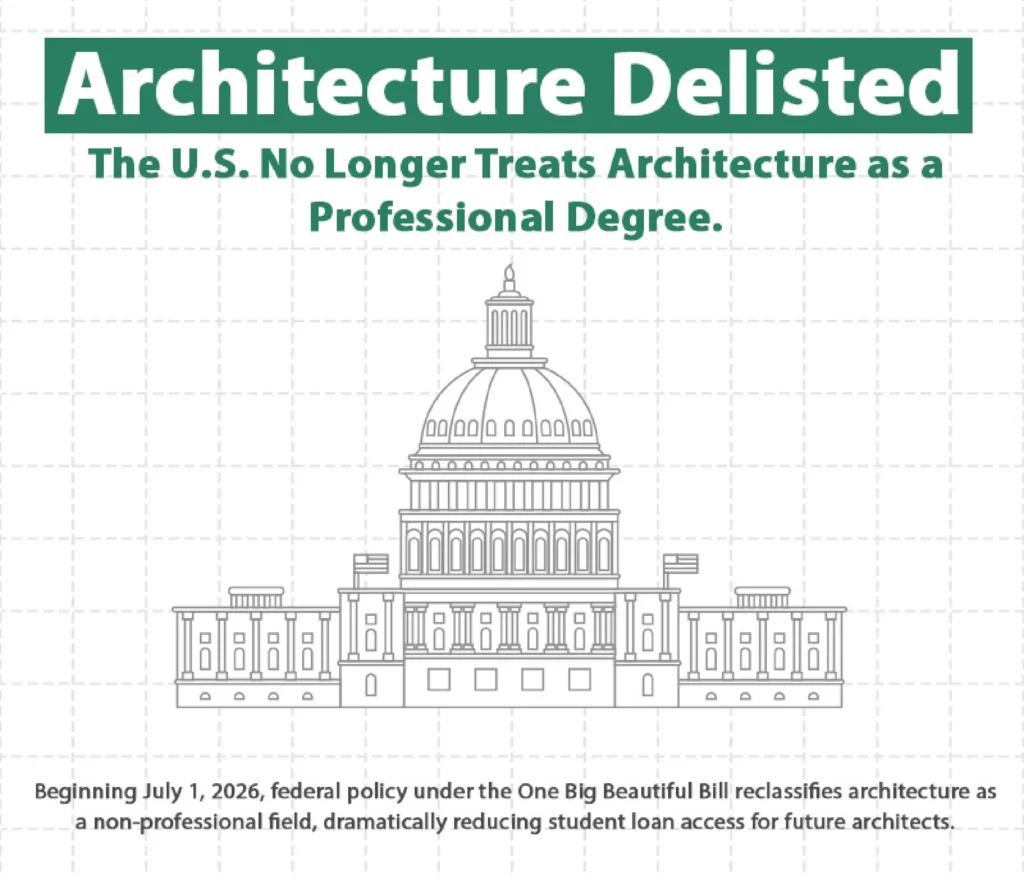
Architecture professional degree delisting has ignited one of the most consequential higher-education debates in years.
It came quietly, disguised as a line item in a 700-page federal bill, but its shock rippled through design studios and drafting rooms across the country. At 8:12 a.m. on a cold November Tuesday, the Department of Education posted a list of “recognized professional degrees” that now excluded architecture—a field whose licensure exams fill nearly 3,000 pages and require up to 5,600 documented training hours. The announcement wasn’t framed as cultural policy or workforce restructuring. It was presented as a “loan modernization update,” the bureaucratic equivalent of removing a cornerstone without warning the builders. “It’s strange,” said one graduate student at Cornell. “I can legally design a hospital, but I can’t borrow like the people who work inside it.” It was the kind of policy change that reveals a country’s hierarchy—quietly, decisively, and with lasting force.
A PROFESSION BUILT ON DEBT MEETS A GOVERNMENT BUILT ON DOUBT
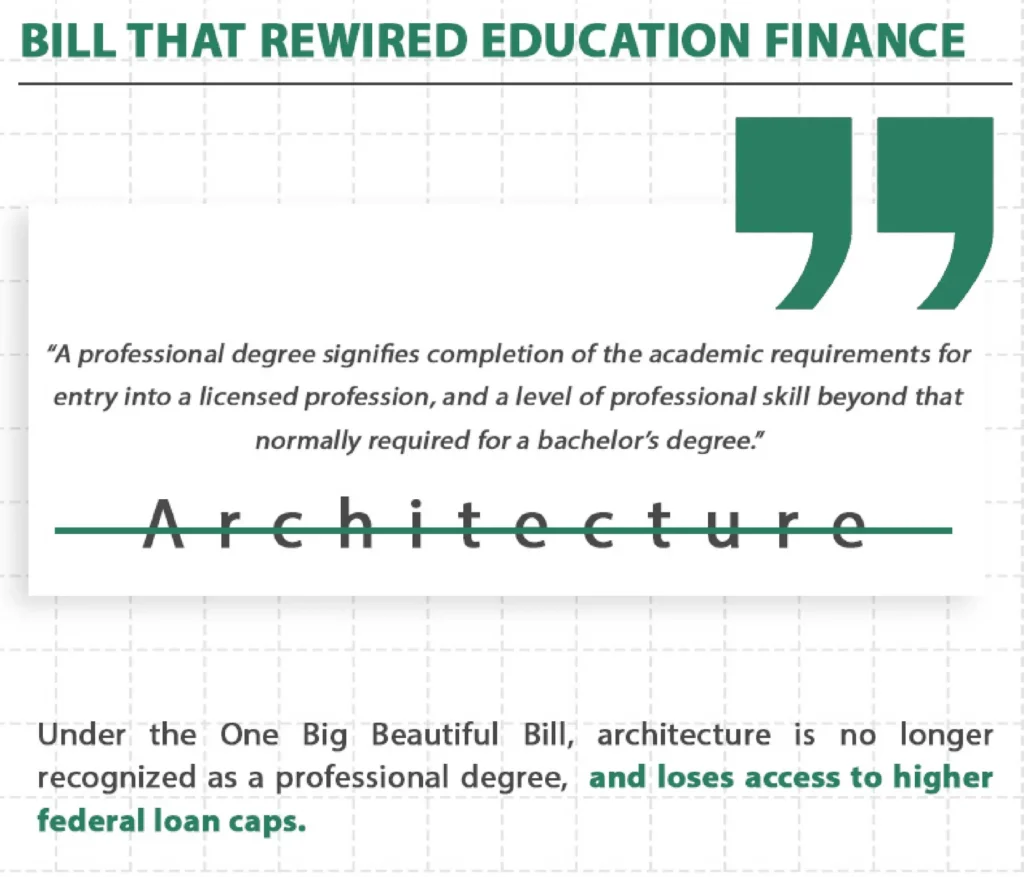
Behind the delisting was a financial logic that felt clinical in its arithmetic and brutal in its implications. The new Repayment Assistance Plan caps loans for “non-professional” degrees at $20,500 a year, barely half the cost of tuition at most accredited programs. Architecture students historically graduate with an average of $123,000 in federal debt, a number already outpacing entry-level salaries by nearly 3:1. The administration’s policy team argued this cap would “limit unsustainable borrowing.” But as one dean at a public university told me, “It doesn’t limit debt, it limits who gets to become an architect.” Months of internal DOE memos, reviewed by academic associations, reveal a belief that the market, not regulation, should define the value of a degree. In that calculus, architecture fell into a category no one expected: dispensable.
A FUTURE BUILT BY FEWER HANDS, FROM FEWER ZIP CODES
The impact stretched far beyond architecture schools’ brick façades and studio lights burning at 3 a.m. Colleges in Rust Belt and rural states reported early signals of anxiety: inquiries dropping, deposits stalling, prospective students emailing to ask if “architecture is still worth it.” At Howard University, administrators fear the policy could slash the number of first-generation students entering their NAAB-accredited program by nearly 40 percent. In interviews, several educators warned that the profession, which already struggles with racial and economic diversity, may slide backwards. “Architecture shapes how people live, move, heal, and learn,” said an urban sociologist at UCLA. “If only the wealthy can afford to study it, you reshape society long before you reshape a city.” Policy shifts create winners and losers; this one threatens to erase entire futures before they begin.
GIS Made Easy – Learn to Map, Analyse, and Transform Urban Futures
THE POLITICS OF A PROFESSION MISUNDERSTOOD
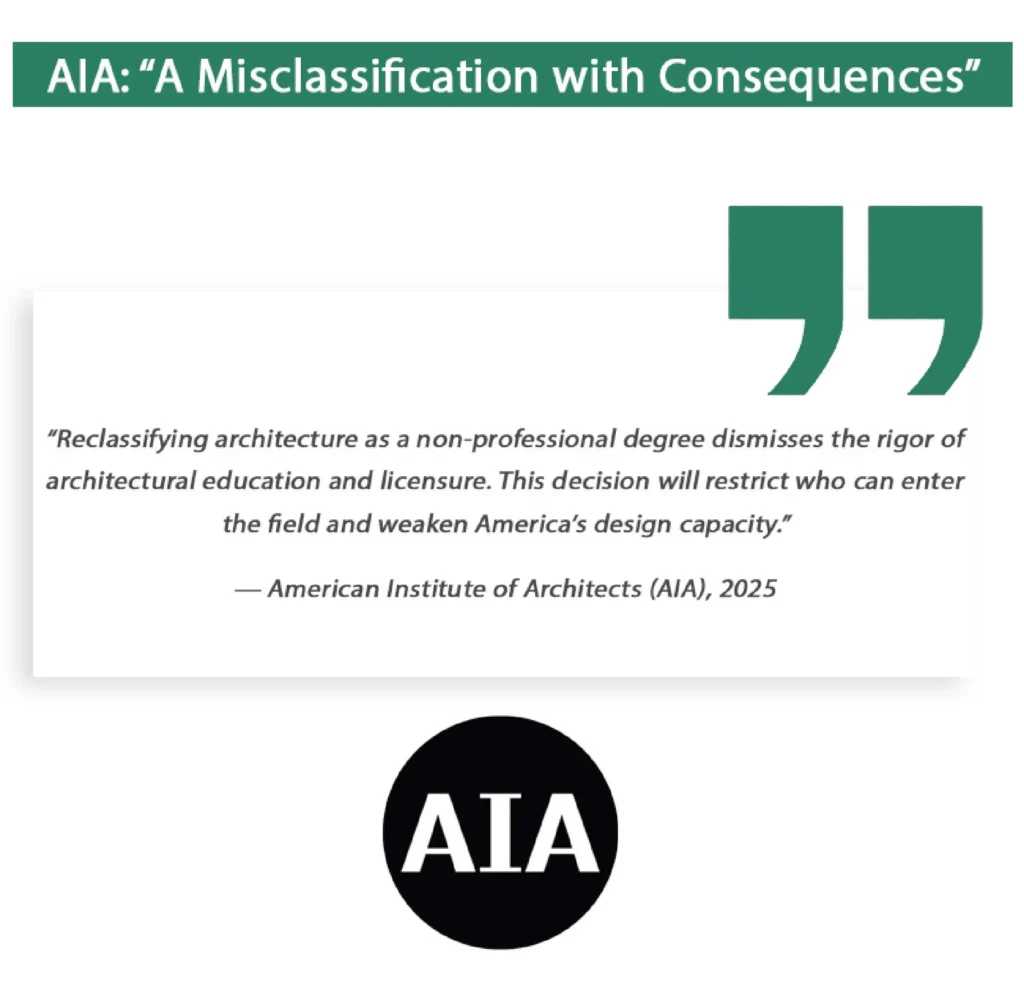
In Washington, the subtext is louder than the statute. This delisting aligns with a broader ideological project—one that favors visible, high-income professions while eroding the public standing of fields seen as “soft power,” including education, social work, and now, architecture. A former senior DOE official, speaking on background, described internal debates where “architecture kept getting framed as an aesthetic field, not a public-safety discipline.” But architects certify egress routes, seismic resistance, ventilation systems, and fire separations, tasks that are quite literally life-and-death. “This is the most dangerous misunderstanding of architecture in half a century,” warned a past AIA president. Policy is often shaped by what lawmakers think a profession is. The tragedy here is that they think architects pick colors, not prevent collapses.

A NATION THAT BUILDS GREAT CITIES BUT SQUEEZES THOSE WHO DESIGN THEM
Even as the federal government narrows the definition of “professional,” America is living through one of the largest infrastructure overhauls in decades—bridges failing, cities densifying, coastlines retreating. The country needs architects more than it has in a generation. Yet it is simultaneously shrinking the pipeline that produces them. Students interviewed for this piece spoke of “mourning,” “identity destabilization,” and “a sense that our work is no longer nationally recognized.” But in the backlash, AIA campaigns, university petitions, a rumored coalition preparing legal action, there’s a reminder that professions endure not because they are federally validated, but because societies cannot function without them. The question isn’t whether architecture is a profession. It’s whether America remembers who built the spaces where its public life unfolds—and what happens when those builders can no longer afford to exist.
GIS Made Easy – Learn to Map, Analyse, and Transform Urban Futures
Urban Design Lab
About the Author
This is the admin account of Urban Design Lab. This account publishes articles written by team members, contributions from guest writers, and other occasional submissions. Please feel free to contact us if you have any questions or comments.