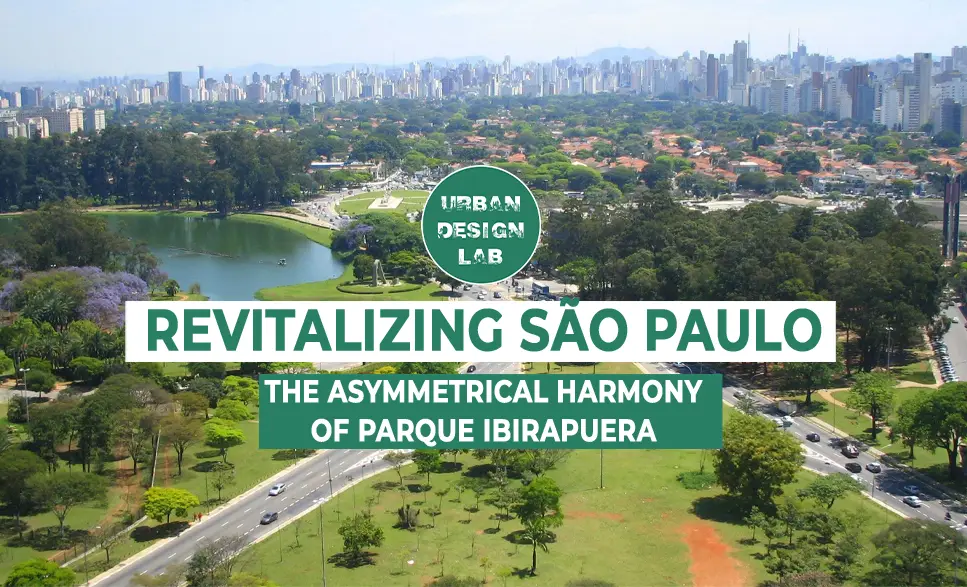
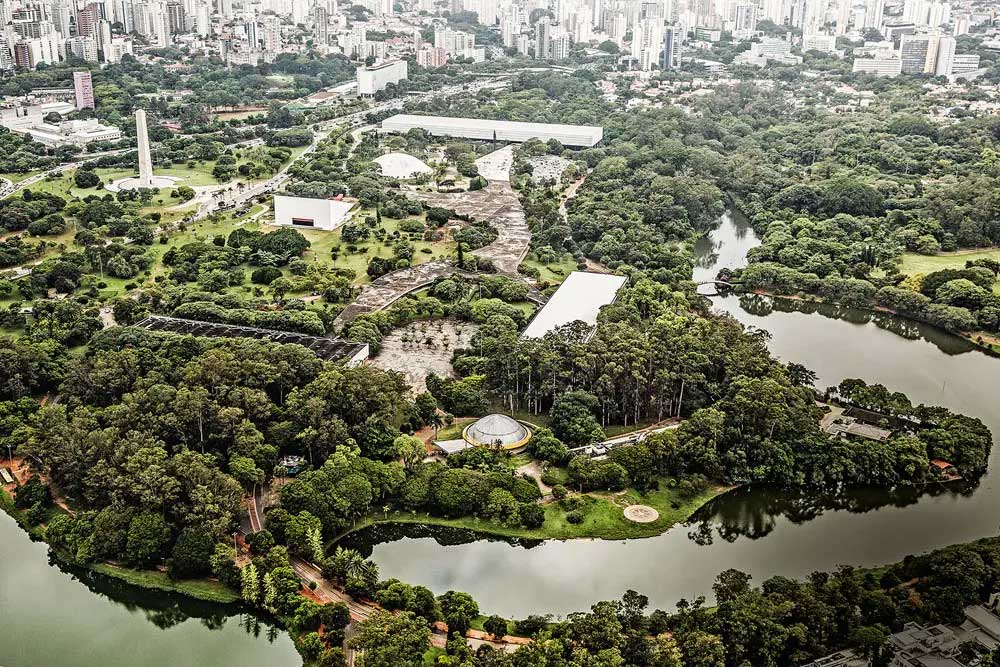
Ibirapuera Park, located in the heart of Sao Paulo, Brazil, is an exceptional piece of the world map of landscape architecture projects, the work of the visionary Roberto Burle Marx. Completed in 1954, this urban oasis spans 158 hectares, offering a multi-layered green space around a dense urban core that balances Brazil’s natural beauty and culture. The scope of the park is limited by 3 avenues: Republic of Lebanon, Pedro Álvarez Cabral, and Fourth Century, and it is one of the first megalithic parks, designed after the great English landscape gardens of the 20th century around the world. The park’s name, “Ibirapuera,” essentially evokes the transformation of urban land from a flood-prone desert into an active and sustainable public space. Its innovative design complements the project with a unique character, creating a haven where asymmetrical harmony reigns, inviting visitors to explore its many landscapes and atmospheres.
Crafting an Organic Harmony According to Marx’s Vision
Roberto Burle Marx, already current for his dedication to modern landscape architecture, simultaneously contributed to the authentic approach to Ibirapuera Park. His author’s philosophy gravitates around the use of domestic plants, multi-layered natural patterns, and fluid forms, which are multiplied along the park. Burle Marx’s work in Ibirapuera is sublimated mastery, where irregular forms and diverse local ecosystems merge into a cohesive, visually stimulating environment.
The park’s composition departs from traditional symmetrical designs, favoring an organic layout that mirrors the natural landscape. This approach is especially legible in expansive lawns, winding paths, and irregularly shaped water pockets. Burle Marx’s genius lies in his ability to create balance, ensuring that each piece of the puzzle contributes to the overall harmony of the park.
One of the most striking features of Park Ibirapuera’s surrealist design according to Moore (2023) is the use of vibrant palettes through the combination of Brazilian vegetation. Burl Marks carefully selected local Brazilian flora, such as bromeliads, orchids, and philodendrons, to create lush, textured landscapes. These plants are arranged in seemingly spontaneous patterns that, up close, reveal an intentional composition aimed at enhancing and conservation of biodiversity and visual appeal of the city (Kabashima et al., 2019).
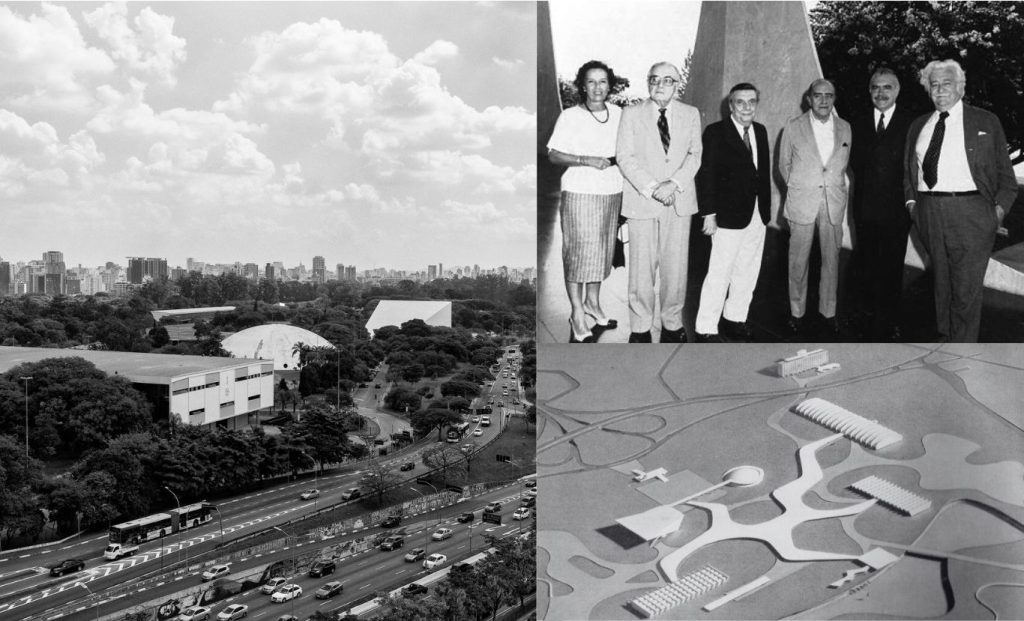
Oscar Niemeyer, José Sarney and Burle Marx in Brasilia, Photo courtesy of Archivo Aló, Rio de Janeiro
Brief Methodological Analysis of Ibirapuera's Design Principles
Vision: demonstration of balance between the plant and mineral worlds.
Inspiration: the great English landscape gardens of the 20th century, the Amazonian igapa.
Composition: The system of paths that connects buildings and gardens freely in the park with gradational extension. Asymmetric distribution of uses in orthogonal archetypal forms, where the city is embedded in a green entity.
Design: avant-garde and modern. Skeptical modern aesthetics, influenced by Cubism with a distinct local Brazilian style. Depth in design is based on communication between flora and fauna. The sense of mobility through the landscape by extending the architecture of an object in the garden.
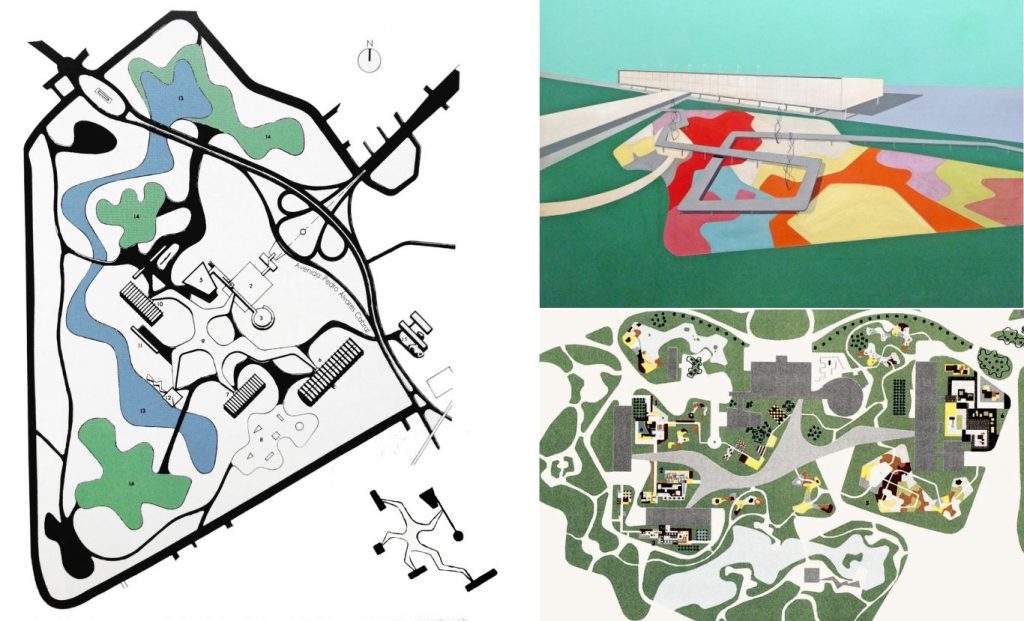
Park Ibirapuera – inicial diagram, site plan and section of R.B. Marx’s landscape design
Source: Website Link
Commitment to Sustainability and Identity
Roberto Burle Marx’s commitment to sustainability is evident in his careful use of materials. The park’s walkways and structures incorporate locally sourced materials, reducing environmental impact and reinforcing a sense of place identity.
Burle Marx’s preference for native plants not only celebrates Brazil’s rich botanical heritage but also promotes environmental sustainability by supporting local wildlife and reducing the need for maintenance.
The park’s free form water structures, including lakes and fountains, serve aesthetic as well as ecological purposes. They provide habitats for various aquatic species and help regulate the park’s microclimate. The integration of these water bodies into the landscape demonstrates Burle Marx’s holistic approach to design, where each element has multiple functions to enhance the overall sustainability of the project.
More Than a Visual Structure and a Functional Public Space
Ibirapuera Park is not only a visual structure but also a functional and diverse space that contributes to the wide range of activities in Sao Paulo. Its design facilitates active and passive recreation, making it an attractive destination for residents and visitors to the city. The extensive network of trails aims to encourage exploration and movement, inviting joggers, cyclists, and walkers.
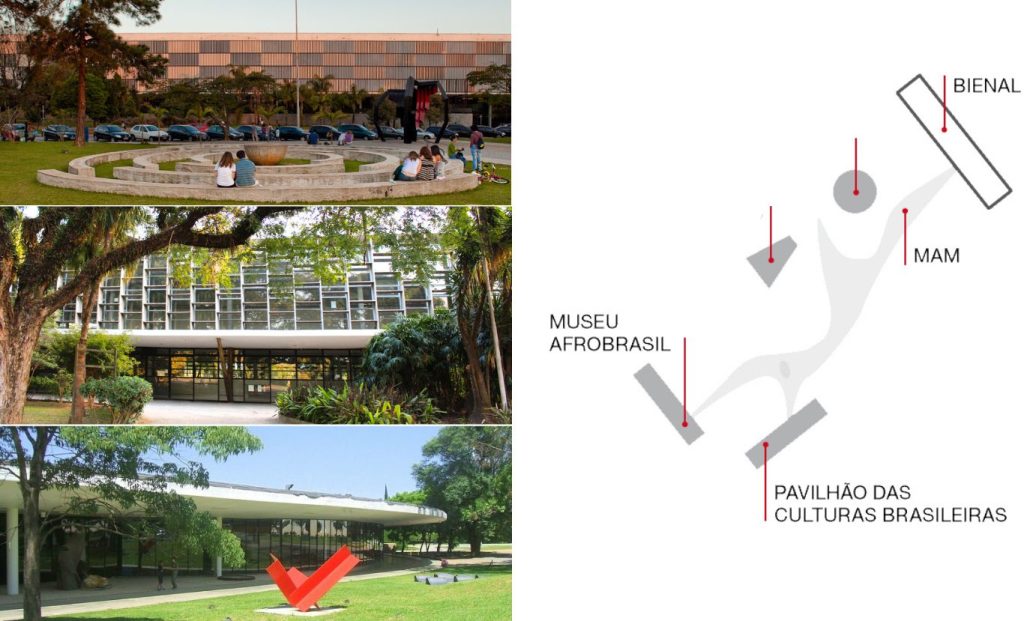
The park also houses several cultural institutions, including the Museum of Modern Art, the Biennial Pavilion, and the Afro-Brazilian Museum. These places offer a rich cultural program, from art exhibitions to educational workshops, reinforcing the role of the park as a center of intellectual and artistic activity.
The integration of these institutions into the park ensures that visitors can seamlessly transition from natural to cultural experiences, reflecting Burle Marx’s versatile vision.
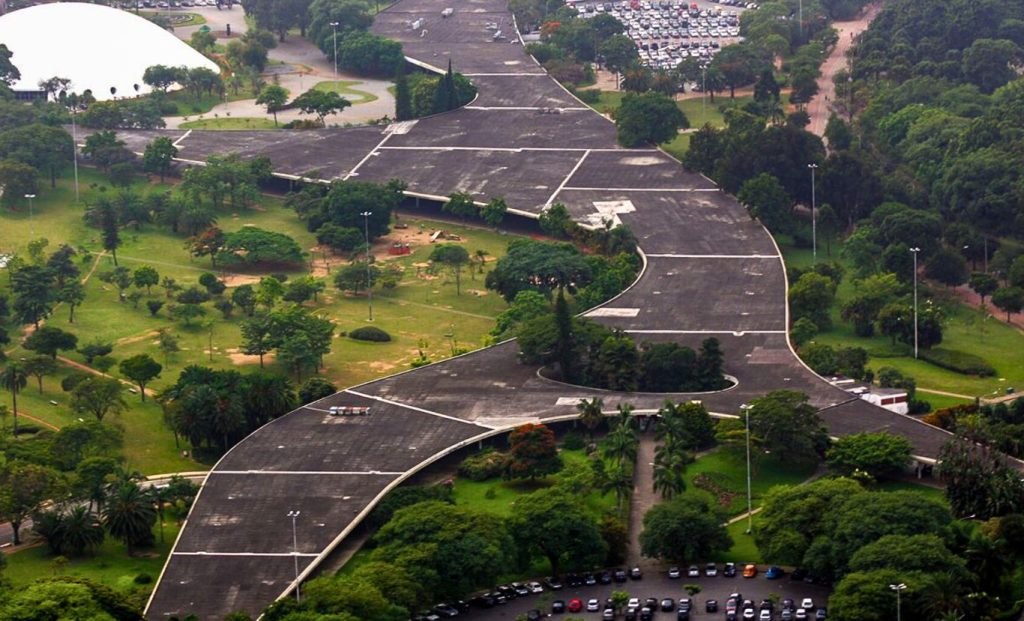
The Marquise of Ibirapuera, structure that connects different buildings in Ibirapuera Park
At the heart of Parque Ibirapuera is the Marquise, a sheer concrete scaly volume, designed by the masterful Oscar Niemeyer. This structure, with its shape, is an example that emphasizes the fluidity of space.
The Marquise as the main connector stretches across the park, creating a sheltered promenade that connects several key elements. Its pointed curves and expansive span blur the boundaries between indoor and outdoor spaces, inviting visitors to meander and explore. The open design not only provides shade and shelter but also hosts a variety of events and activities, from art exhibitions to skateboarding, making it a dynamic and multi-functional space.
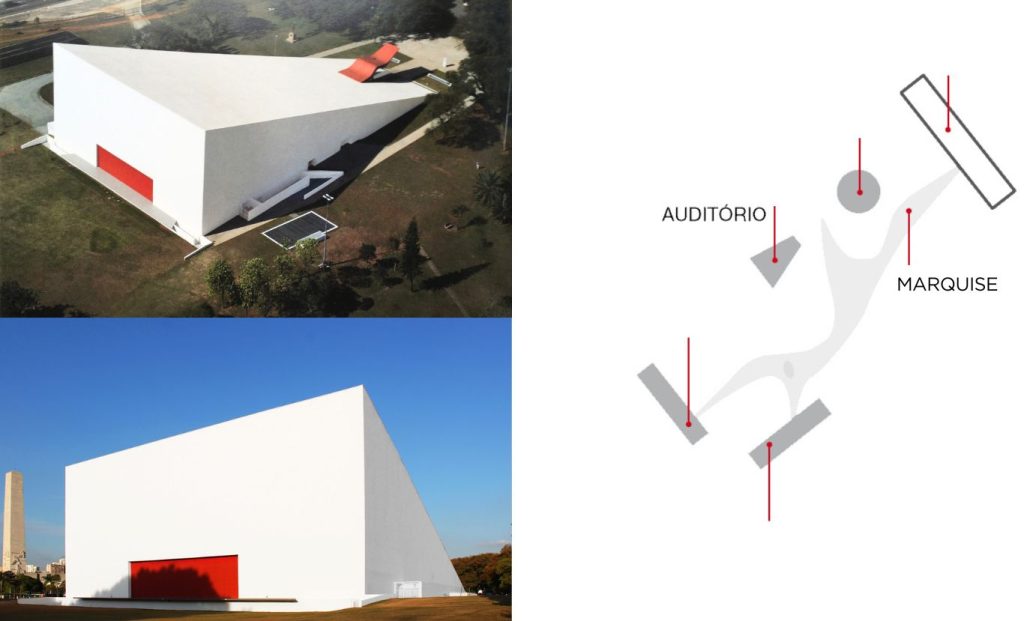
Adjacent to the Marquise is the Biennial Pavilion, another Niemeyer masterpiece. This building is a center for contemporary art, hosting the prestigious Sao Paulo Art Biennale. The design of the world’s second-oldest international art biennial (Sao Paolo, 2024), reflects Niemeyer’s unwavering commitment to modernist principles, characterized by clean lines, open spaces, and harmonious integration with the surrounding landscape. Its facade, composed of large glass panels, allows natural light to flood the exhibition spaces, offering visitors across the social spectrum a seamless, fluid connection with nature.
Inside, the pavilion contains a series of modular exhibition halls that can be adapted for different types of installations. The minimalist interior design provides a neutral backdrop that allows the art to take center stage. The use of a skeletal construction system and movable partitions offers flexibility, allowing curators to create different spatial experiences accordingly. This adaptability underscores Niemeyer’s foresight in design that evolves in proportion to the changing needs of contemporary art.
Schematic view of The Afro-Brazil Museum, Museum of Modern Art and Biennial Pavilion of Sao Paolo
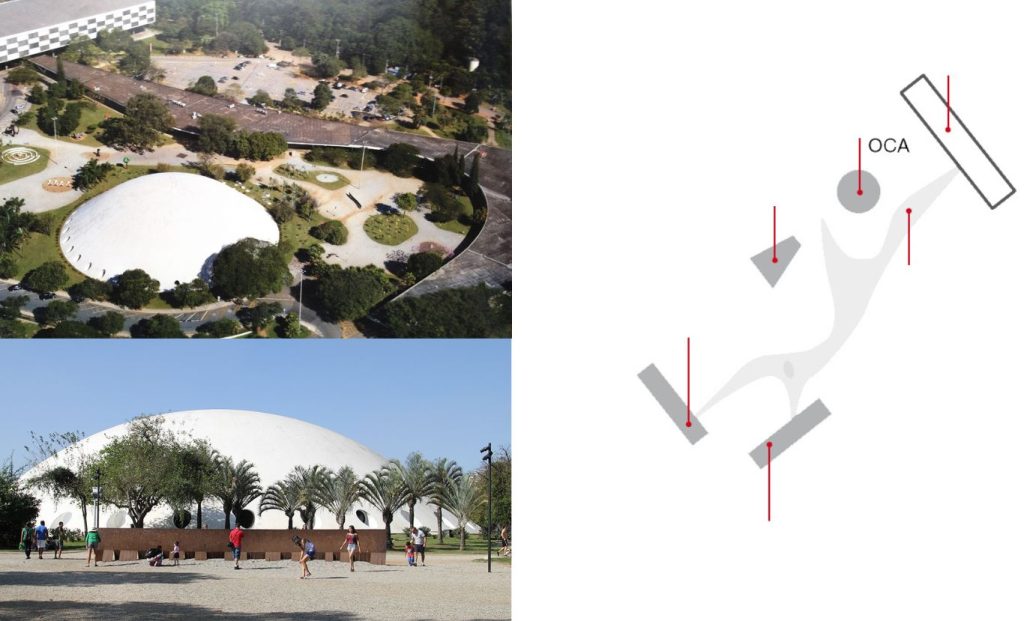
One of the most visually striking buildings in Ibirapuera Park is Oka, the futuristic dome designed by Oscar Niemeyer. This white spaceship-like structure represents Niemeyer’s avant-garde approach to architecture. Oca’s smooth, sinuous form and all-white facade create a dramatic contrast to the park’s lush greenery. The design of the building is bold and functional, offering a multifunctional space for a series of cultural events.
The interior of the Oca is as impressive as its exterior. The expansive space is made possible by the innovative use of reinforced concrete, which supports the dome without the need for internal columns. This open plan allows for maximum flexibility in the layout of exhibits and installations. Windows at the top of the dome flood the interior with natural light, enhancing the feeling of openness. Oca’s futuristic design makes it a beloved landmark and testament to Niemeyer’s visionary genius.
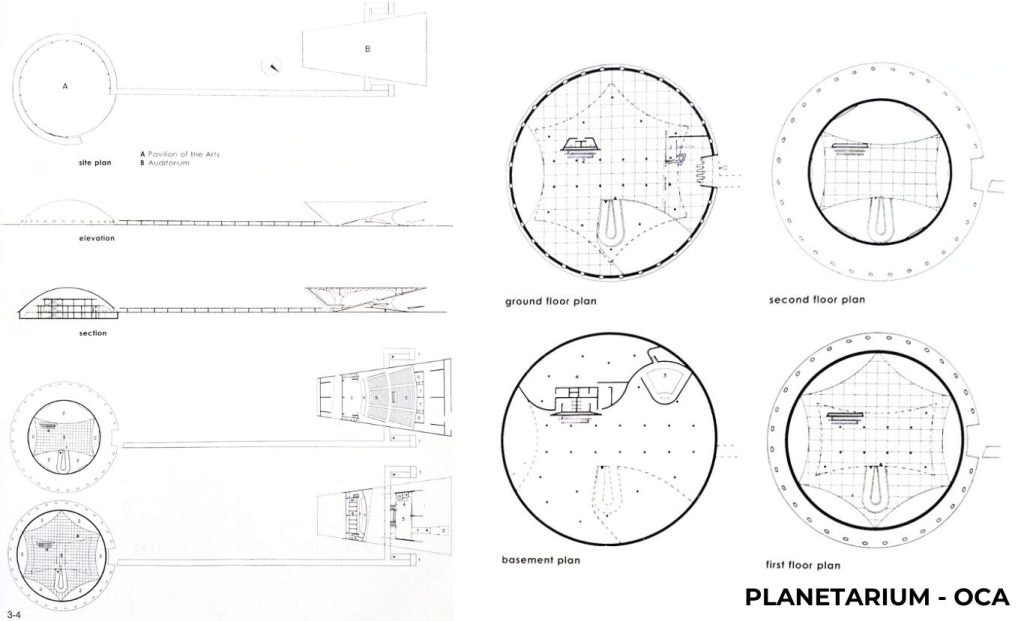
Schematic and several views of the Planetarium, OCA
Housed in a pavilion originally designed for Sao Paulo’s 400th anniversary celebrations, the Museum of Afro-Brazilian Art is a vital cultural institution that celebrates Afro-Brazilian heritage. The building itself is an excellent example of mid-20th-century modernist architecture, characterized by clean lines, geometric shapes, and integration with the surrounding landscape. The design of the museum facilitates a narrative journey through the rich history and culture of Afro-Brazilians, with compositionally fused exhibition spaces that lead visitors through a chronological and thematic journey.
The museum’s interiors are designed to create an immersive experience, with high ceilings and spacious galleries and interactive exhibits. The use of natural materials, such as wood and stone, in interior design adds warmth and texture to the interior. This thoughtful design ensures that the Afro-Brazilian Museum is not just a simple repository of history but a vibrant space that engages and educates visitors.
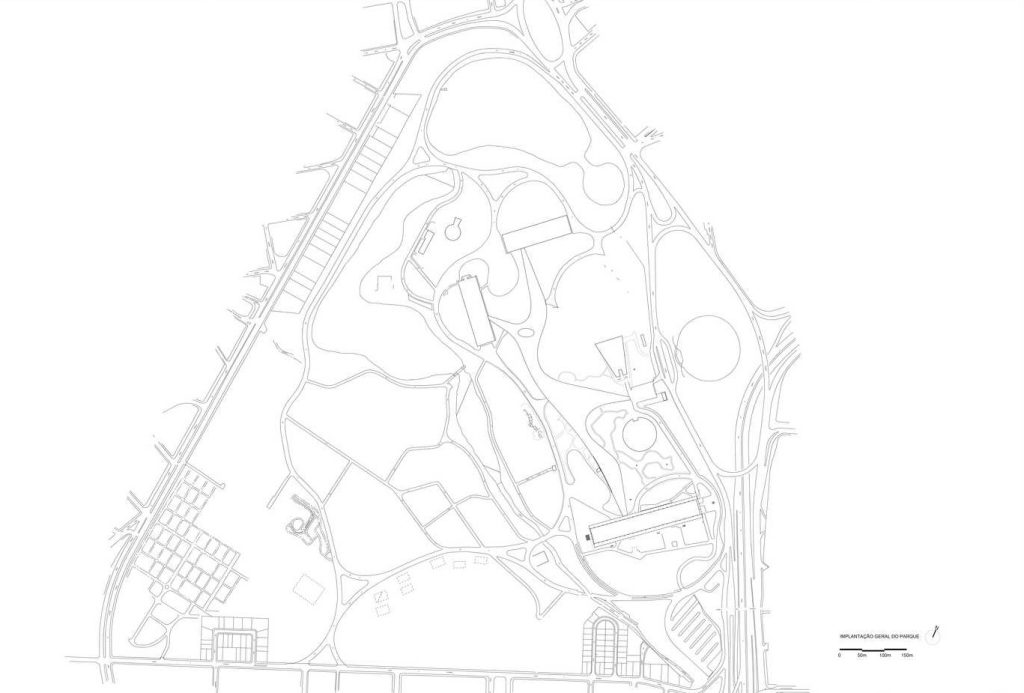
Park Ibirapuera – technical drawings for Town Hall – Afrobrazilian Museum
The Ibirapuera Planetarium, the only work by Hélio Uchôa in the park, serves scientific and educational purposes. The elegant dome-shaped structure of the planetarium is reminiscent of futuristic designs, inviting visitors to embark on a journey through the cosmos. Its exterior, clad in reflective materials, reflects the surrounding greenery, creating a harmonious integration with the park.
Inside, the planetarium features advanced projection systems and comfortable seating arrangements, offering an immersive astronomical experience. The dome’s design facilitates 360-degree views at night, enhancing educational programs and current star shows. The planetarium’s architecture not only serves its functional purpose but also inspires curiosity about the universe, aligning with the park’s broader mission and vision of being a cradle of educational and cultural enrichment.
Park Ibirapuera – technical drawings for Planetarium – OCA
Ibirapuera Park: Cultural Beacon of Brazilian Modernism
The historical impact and architectural features of Ibirapuera Park on Sao Paulo ’s urban landscape (Ibirapuera Park, n.d.) and its inhabitants is truly immeasurable in many ways. It serves as a green lung for the bustling metropolis, offering a refuge from the urban environment and contributing to the health of the city’s environment. The park’s vast green spaces help mitigate air pollution, reduce the effects of urban heat islands, and provide key habitats for local wildlife.
Culturally, the park is a beacon of Brazilian modernism, displaying the excellence of the collaboration of Roberto Burle Marx and other prominent architects such as Oscar Niemeyer and Helio Uchoa. It stands as a testament to Brazil’s rich artistic and architectural heritage, attracting millions of visitors annually who come to enjoy its beauty.
Ibirapuera Park has also gained international recognition, earning the epithet among the most famous urban parks in the world (Moore, 2023). Its innovative design and successful integration of natural and cultural elements have made it a model for urban park design globally. The enduring popularity and continuing relevance of the park underscore its significance as an authentic city landmark of landscape architecture.
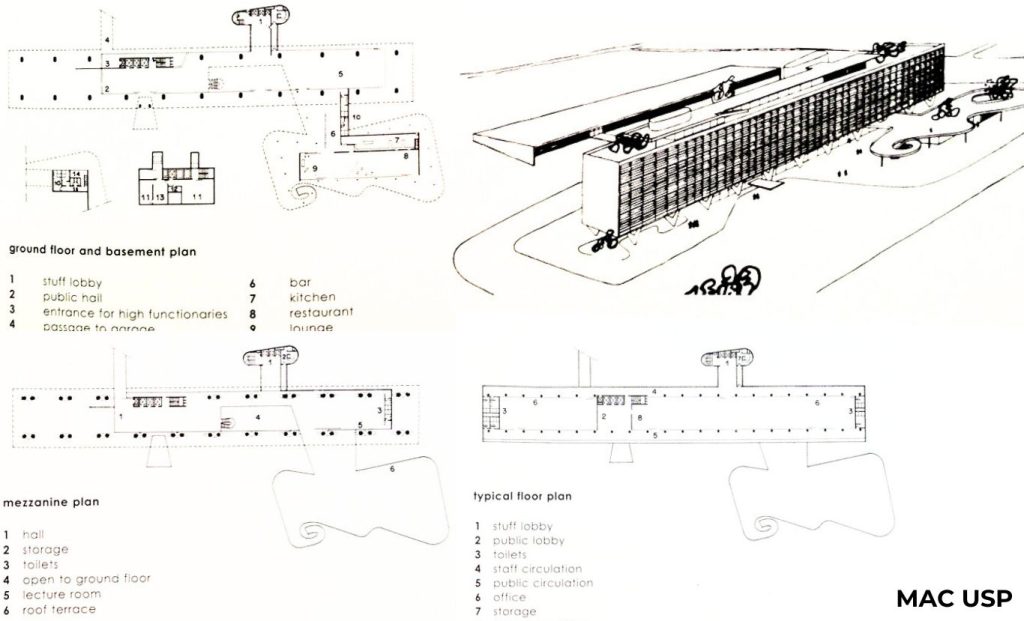
Park Ibirapuera – technical drawings for Museum of Contemporary Art
Ibirapuera Park showcases the harmonious blend of nature and culture through the visionary design of Roberto Burle Marx. Its asymmetrical layout, vibrant plant palettes, free-form bodies of water and careful integration of cultural institutions create a dynamic space that caters to a variety of recreational and intellectual pursuits. The park’s sustainable design practices and environmental contributions further enhance its value, making it a vital green space in the heart of So Paulo. As a living legacy of Burle Marx’s genius, Ibirapuera Park continues to inspire and delight visitors, embodying the principles of asymmetric harmony (Roberto Burle Marx, Oscar Niemeyer Ibirapuera Park Project, 1953, n.d.), collaboration, and a holistic approach as a winning formula in landscape architecture.
References
Arquitectónicos, P. (n.d.). E3: art. Recintos.
Arquitextos 051.01: O parque do Ibirapuera: 1890 a 1954 | vitruvius. (n.d.)
Curi, F. A. (2017). Burle Marx et le parc Ibirapuera : quatre décennies de rendez-vous manqués (1953-1993). Brésil(S), 12.
Kabashima, Y., Andrade, M. L. F., Gandara, F. B., Tomas, F. L., Polizel, J. L., Velasco, G. D. N., Da Silva, L. F., Dozzo, A. D. P., Moura, R. G., & Da Silva Filho, D. F. (2019). HISTÓRICO DA COMPOSIÇÃO DA VEGETAÇÃO ARBÓREA DO PARQUE DO IBIRAPUERA e SUA CONTRIBUIÇÃO. Revista Da Sociedade Brasileira De Arborização Urbana, 6(4), 125.
Roberto Burle Marx, Oscar Niemeyer Ibirapuera Park Project, São Paulo, Brazil (Site Plan) 1953. (n.d.). MoMA. Retrieved September 22, 2024, https://www.moma.org/collection/works/252
An innovative urban planner with six years of experience, dedicated to sustainable communities. Holding a Master’s in Architecture, she explores hybridity in spatial formation and new museology. As a specialist, she excels in policy analysis and community development. An urban activist and writer for Porta 3, she raises awareness of social issues in urban planning. As founder of Esquina Urbana, she merges environmental psychology and planning, advocating for enhanced urban mobility and endless bike lanes.
Dear Sir/ Madam,
My name is Nadeem Ahmed and I am an engineer by profession and have received Master degree from USA. My interest in Urban Planning urged me to create and formulate something new and novel in this field which has never been thought by any human being. My intellectual property is protected by international laws regards to intellectual properties and is called as “Harmonic Human Settlements” a high speed, Social Activity Energy Classified Urban Planning based on how historically human societies evolved, and may only be used with my permission and based on royalty.
All man does in a Society are Social Activities; Each Social Activity requires certain level of mental and physical energy and you may call this Social Activity Energy; All these Social Activities should happen in Social Activity Centers; Classification of such Social Activity Energies and placing their Centers in Harmonic Pattern spatially would create Urban Developments which would only require optimal energies to perform such Social Activities, by minimizing the mobilization to reach such specific Social Activity Centers and almost without trespassing any other Domains and Social Activity Centers.
My Harmonic Urban Planning can create urban areas with high speed mobilization but at the same time minimized and optimal mobilization by road and space because it starts with basic building unit called Private Residential Domains with residential units only and then it creates a Strata by revolving these Private Residential Domains around a Social Center with activities requiring lowest or Type Social Activities Energy, called Family Centers and then this whole setup revolves around another higher Social Activity or Type Center called Neighborhood Centers which then revolves around next higher Social Energy or Type and vice versa. Flying Cars and other fast means of transportation would also be possible in such Urban Planning Infra Structures.
The salient features would be:
* This type of urban planning would have specific logical definition of Start and Conclusion of an urban human settlement.
* High speed mobilization.
* Optimally minimized mobilization.
* Systemic, Harmonized and Classified Social Activity Centers. Hence each dwellers would know exactly where to go for the related social activities such that distances would increase only with the increase of Social Activity Energy Levels or Types.
* Almost No Trespassing.
* The most amazing characteristic of this urbanization is such that each dweller would travel almost approximately same distance for each specific social activity such as going to school, college, university, shopping centers, restaurants, banks, airport etc no matter where the dweller lives within this urban settlement.
* This is because of Harmonic nature each Social Activity Center would re-emerge again and again harmonically to optimize and minimize the mobilizations.
I know you are among the best urban planners of this world. My idea can help building a collaboration between us and our co-operation and team work can help the world by establishing huge high speed urban developments not just in USA, Europe but all over the world with the help of the related governments. I can be your right hand in negotiating and giving Harmonic Urban Planning Proposal Presentations to governments and authorities and make efforts with you to get the projects and implement them. In return I would also like to get rewards as royalty though with principle goal for serving humanity and in the way of serving humanity.
My Book “Socio-Cultural Harmonic Human Settlements and Urbanization” is available on almost all the Global publishing websites and forums. I can give you an online presentation on my Harmonic Urban Planning which would be worth watching and observing.
I, therefore, request you to give me an opportunity for the presentation on my intellectual creation. I would make your time worth and I shall be grateful to you.
Sincerely
Nadeem Ahmed
Mobile: 1-848-329-2165
WhatsApp:
1-848-329-2165 [email protected]
Book Title: Socio-Cultural Harmonic Human Settlements and Urbanization is available on all the international forums of publishing including Amazon, Barnes and Noble, Apple Books, kobo, Ebay, Everand, AuthorHouse and others
“Let’s explore the new avenues of Urban environment together “
We use cookies on our website to give you the most relevant experience by remembering your preferences and repeat visits. By clicking “Accept”, you consent to the use of all the cookies. Read More
This website uses cookies to improve your experience while you navigate through the website. Out of these, the cookies that are categorized as necessary are stored on your browser as they are essential for the working of basic functionalities of the website. We also use third-party cookies that help us analyze and understand how you use this website. These cookies will be stored in your browser only with your consent. You also have the option to opt-out of these cookies. But opting out of some of these cookies may affect your browsing experience.
Necessary cookies are absolutely essential for the website to function properly. These cookies ensure basic functionalities and security features of the website, anonymously.
Cookie
Duration
Description
viewed_cookie_policy
11 months
The cookie is set by the GDPR Cookie Consent plugin and is used to store whether or not user has consented to the use of cookies. It does not store any personal data.
cookielawinfo-checkbox-analytics
11 months
This cookie is set by GDPR Cookie Consent plugin. The cookie is used to store the user consent for the cookies in the category "Analytics".
cookielawinfo-checkbox-performance
11 months
This cookie is set by GDPR Cookie Consent plugin. The cookie is used to store the user consent for the cookies in the category "Performance".
cookielawinfo-checkbox-others
11 months
This cookie is set by GDPR Cookie Consent plugin. The cookie is used to store the user consent for the cookies in the category "Other.
cookielawinfo-checkbox-functional
11 months
The cookie is set by GDPR cookie consent to record the user consent for the cookies in the category "Functional".
cookielawinfo-checkbox-necessary
11 months
This cookie is set by GDPR Cookie Consent plugin. The cookies is used to store the user consent for the cookies in the category "Necessary".
Functional cookies help to perform certain functionalities like sharing the content of the website on social media platforms, collect feedbacks, and other third-party features.
Performance cookies are used to understand and analyze the key performance indexes of the website which helps in delivering a better user experience for the visitors.
Analytical cookies are used to understand how visitors interact with the website. These cookies help provide information on metrics the number of visitors, bounce rate, traffic source, etc.
Advertisement cookies are used to provide visitors with relevant ads and marketing campaigns. These cookies track visitors across websites and collect information to provide customized ads.







One Comment
Dear Sir/ Madam,
My name is Nadeem Ahmed and I am an engineer by profession and have received Master degree from USA. My interest in Urban Planning urged me to create and formulate something new and novel in this field which has never been thought by any human being. My intellectual property is protected by international laws regards to intellectual properties and is called as “Harmonic Human Settlements” a high speed, Social Activity Energy Classified Urban Planning based on how historically human societies evolved, and may only be used with my permission and based on royalty.
All man does in a Society are Social Activities; Each Social Activity requires certain level of mental and physical energy and you may call this Social Activity Energy; All these Social Activities should happen in Social Activity Centers; Classification of such Social Activity Energies and placing their Centers in Harmonic Pattern spatially would create Urban Developments which would only require optimal energies to perform such Social Activities, by minimizing the mobilization to reach such specific Social Activity Centers and almost without trespassing any other Domains and Social Activity Centers.
My Harmonic Urban Planning can create urban areas with high speed mobilization but at the same time minimized and optimal mobilization by road and space because it starts with basic building unit called Private Residential Domains with residential units only and then it creates a Strata by revolving these Private Residential Domains around a Social Center with activities requiring lowest or Type Social Activities Energy, called Family Centers and then this whole setup revolves around another higher Social Activity or Type Center called Neighborhood Centers which then revolves around next higher Social Energy or Type and vice versa. Flying Cars and other fast means of transportation would also be possible in such Urban Planning Infra Structures.
The salient features would be:
* This type of urban planning would have specific logical definition of Start and Conclusion of an urban human settlement.
* High speed mobilization.
* Optimally minimized mobilization.
* Systemic, Harmonized and Classified Social Activity Centers. Hence each dwellers would know exactly where to go for the related social activities such that distances would increase only with the increase of Social Activity Energy Levels or Types.
* Almost No Trespassing.
* The most amazing characteristic of this urbanization is such that each dweller would travel almost approximately same distance for each specific social activity such as going to school, college, university, shopping centers, restaurants, banks, airport etc no matter where the dweller lives within this urban settlement.
* This is because of Harmonic nature each Social Activity Center would re-emerge again and again harmonically to optimize and minimize the mobilizations.
I know you are among the best urban planners of this world. My idea can help building a collaboration between us and our co-operation and team work can help the world by establishing huge high speed urban developments not just in USA, Europe but all over the world with the help of the related governments. I can be your right hand in negotiating and giving Harmonic Urban Planning Proposal Presentations to governments and authorities and make efforts with you to get the projects and implement them. In return I would also like to get rewards as royalty though with principle goal for serving humanity and in the way of serving humanity.
My Book “Socio-Cultural Harmonic Human Settlements and Urbanization” is available on almost all the Global publishing websites and forums. I can give you an online presentation on my Harmonic Urban Planning which would be worth watching and observing.
I, therefore, request you to give me an opportunity for the presentation on my intellectual creation. I would make your time worth and I shall be grateful to you.
Sincerely
Nadeem Ahmed
Mobile: 1-848-329-2165
WhatsApp:
1-848-329-2165
[email protected]
Book Title: Socio-Cultural Harmonic Human Settlements and Urbanization is available on all the international forums of publishing including Amazon, Barnes and Noble, Apple Books, kobo, Ebay, Everand, AuthorHouse and others