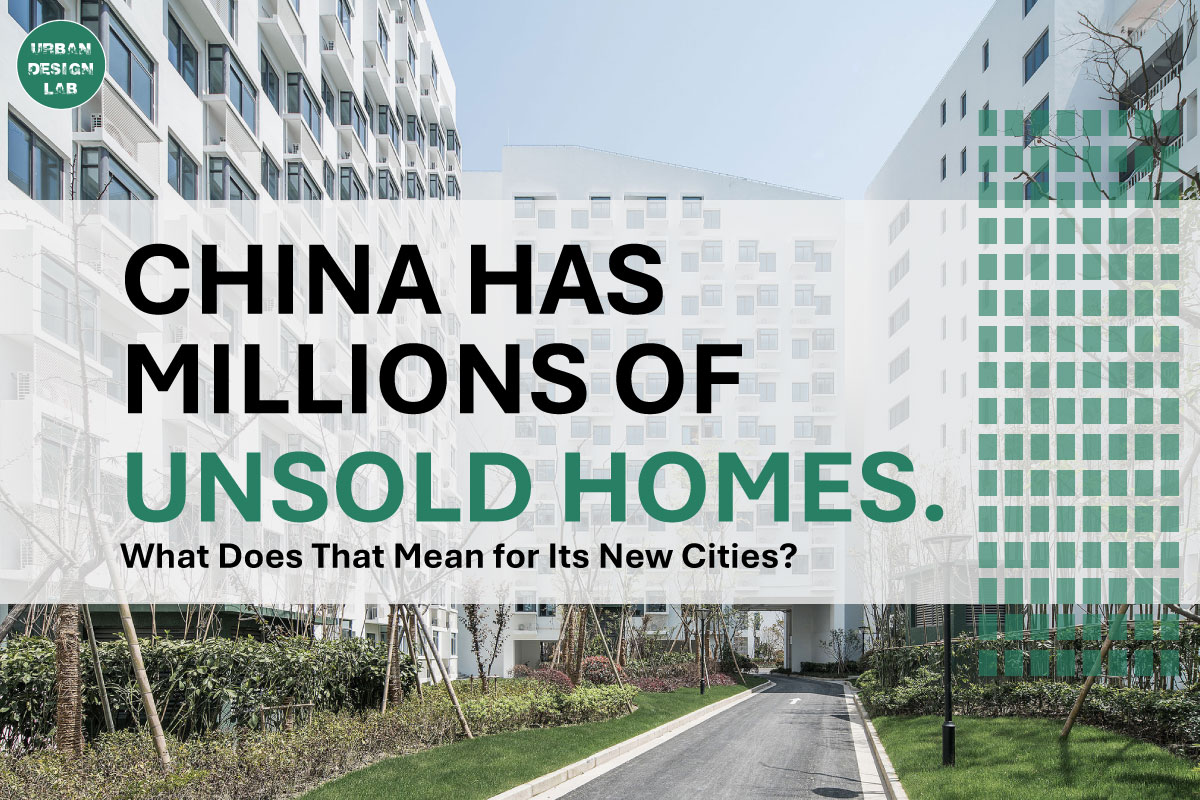


A completed apartment building is not necessarily a functioning neighbourhood. Its structure may be finished while the employment, services, transport connections and household confidence needed to sustain everyday life remain incomplete. China’s housing surplus makes this distinction particularly important: the challenge extends beyond selling property to determining which urban districts can support durable communities.
The scale is substantial. At the end of August 2026, China recorded 400.83 million square metres of completed residential floor space available for sale, according to the National Bureau of Statistics. This is a floor-area measure, not an official count of vacant dwellings. Nevertheless, it establishes the magnitude of the accumulated residential inventory. stats.gov.cn
For architects and planners, the central question is what this surplus means spatially. Will newly built districts gradually attract residents? Can existing apartments become affordable rental housing? Which places need better connections and services, and where should further expansion stop?
This article argues that China’s new cities should be assessed through their capacity to support occupation, access and long-term maintenance. Unsold housing is a warning signal, but its implications depend on location, ownership, completion status and the relationship between residential construction and the wider urban economy.
What the Housing Inventory Actually Measures
Discussion of China’s property crisis frequently combines several different conditions: completed homes that developers have not sold, apartments purchased but left unoccupied, unfinished homes already sold to buyers, and projects still under construction. These categories overlap in public debate, but they do not describe the same problem.
The National Bureau of Statistics defines floor space available for sale as completed property available for sale or lease that remains unsold or unleased. Its broader total includes residential and non-residential buildings. It therefore cannot be treated as a national census of empty apartments, nor does it capture all unfinished presold housing. stats.gov.cn
To illustrate scale, dividing the reported residential inventory by an assumed 100 square metres per dwelling produces approximately four million dwelling-equivalents. This is an illustrative calculation using the official floor-area figure, not a verified dwelling count. Actual apartment sizes and the composition of the inventory would change the result.
That qualification matters because the headline “millions of unsold homes” can otherwise suggest a precision that the underlying statistics do not provide. It also risks implying that every dwelling represented by the estimate belongs to an entirely empty city.
For planning purposes, the more useful questions concern the condition and location of each development. A completed apartment near established employment has a different recovery pathway from an unfinished tower far from services. A privately owned vacant dwelling raises different management questions from a developer-owned apartment available for acquisition.
The distinction also determines who needs protection. Buyers waiting for an unfinished home require a delivery or compensation solution. Households unable to afford suitable accommodation require accessible housing. Municipalities responsible for underused infrastructure require a sustainable operating strategy. An intervention that helps one group may leave the others unaffected.
A credible local assessment should therefore record completion status, ownership, legal encumbrances, actual occupation, asking rents, service provision and access to employment. These are proposed diagnostic requirements, not claims that a comprehensive public dataset already exists. Without them, a national inventory figure can identify the scale of concern while revealing little about the appropriate treatment of a particular neighbourhood.
Why the Surplus Challenges the Economics of Urban Expansion
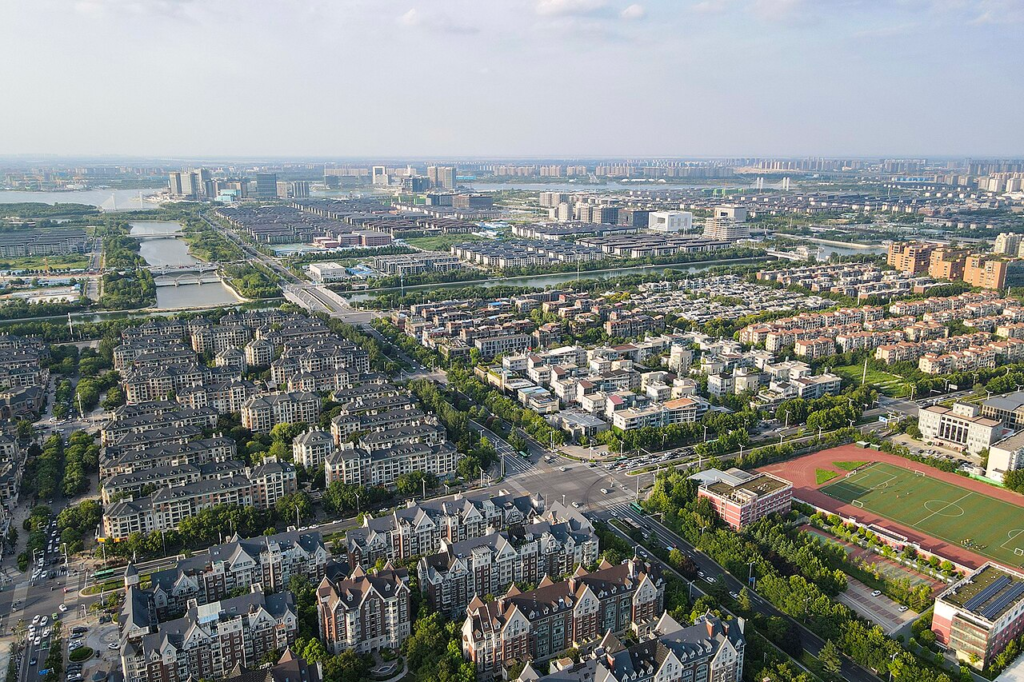
Housing construction becomes an urban development problem when expectations about future residents are built into present-day spending. Roads, utilities, public buildings and development parcels may be planned around a population that has not yet arrived. The resulting exposure concerns both property investment and the cost of operating the district.
The institutional connections are well established. The joint World Bank and Development Research Center report, Urban China: Toward Efficient, Inclusive, and Sustainable Urbanization, identified land management, municipal finance, household registration and urban design as interconnected reform priorities. It recommended more sustainable local revenues, more efficient land use and better integration between transport and urban centres. worldbank.org
The implication is that unsold housing cannot be understood entirely through mortgage conditions or developer balance sheets. A district may have been designed around assumptions about land values, future construction and population growth. If those assumptions weaken, the financial basis for its services needs reassessment.
Demography further complicates the expectation that time alone will absorb excess supply. The IMF’s analysis of China’s medium-term property adjustment identifies population decline and slowing urbanisation as constraints on future demand for additional housing. It also notes that previous demand generated through large-scale replacement of older accommodation cannot be assumed to continue at the same intensity. These are structural considerations, rather than a forecast that every city will lose residents. imf.org
National demographic change does not distribute itself evenly. For a local planning decision, the relevant test is whether a district can attract and retain households under realistic employment and income conditions. An aggregate population projection cannot substitute for an assessment of the actual households likely to live there.
This distinction suggests three possible trajectories. Some districts may experience delayed occupation because housing preceded services. Others may face a mismatch between available units and what prospective residents can afford. A third group may have more capacity than plausible local demand can support.
These are analytical scenarios, not an official classification of Chinese cities. Their value is that they discourage a uniform response. Better bus services might help the first district; a viable rental conversion programme might assist the second. Neither necessarily justifies continued expansion in the third.
Public expenditure should consequently be assessed against the cost of making existing neighbourhoods work. Before approving another peripheral development, a municipality should compare its expected benefits with completing infrastructure and services in places where homes already exist. The relevant planning question is whether the next investment improves urban life enough to justify its full capital and operating costs.
Kangbashi and the Limits of the “Ghost City” Label
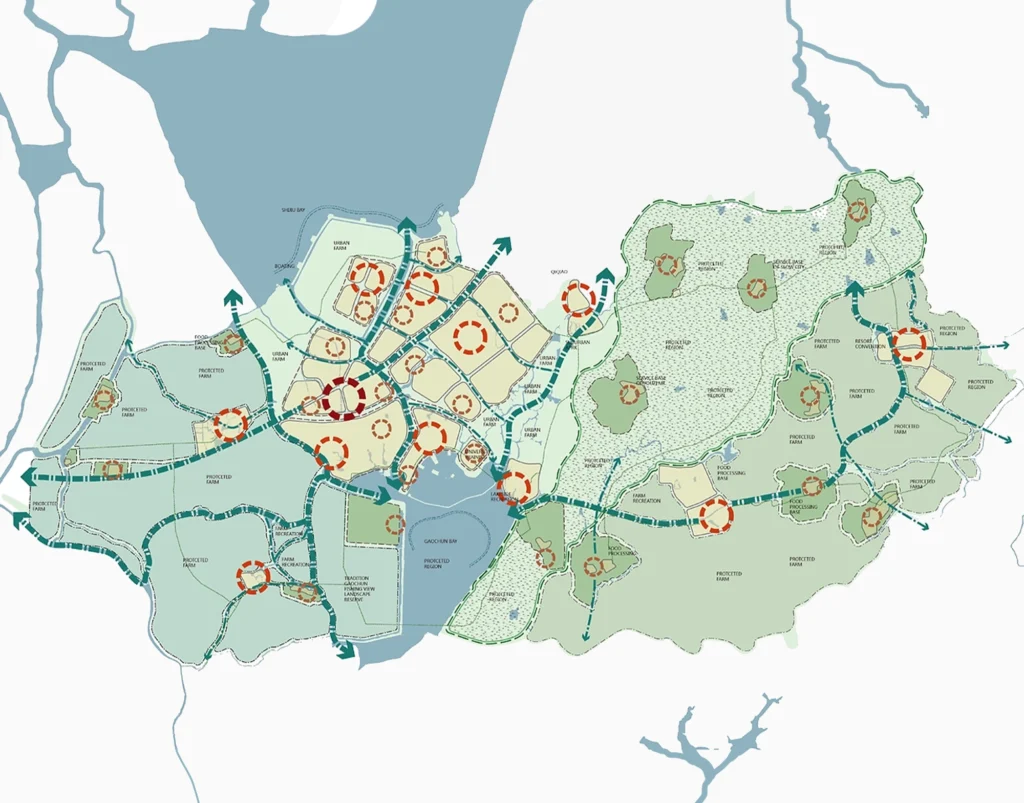
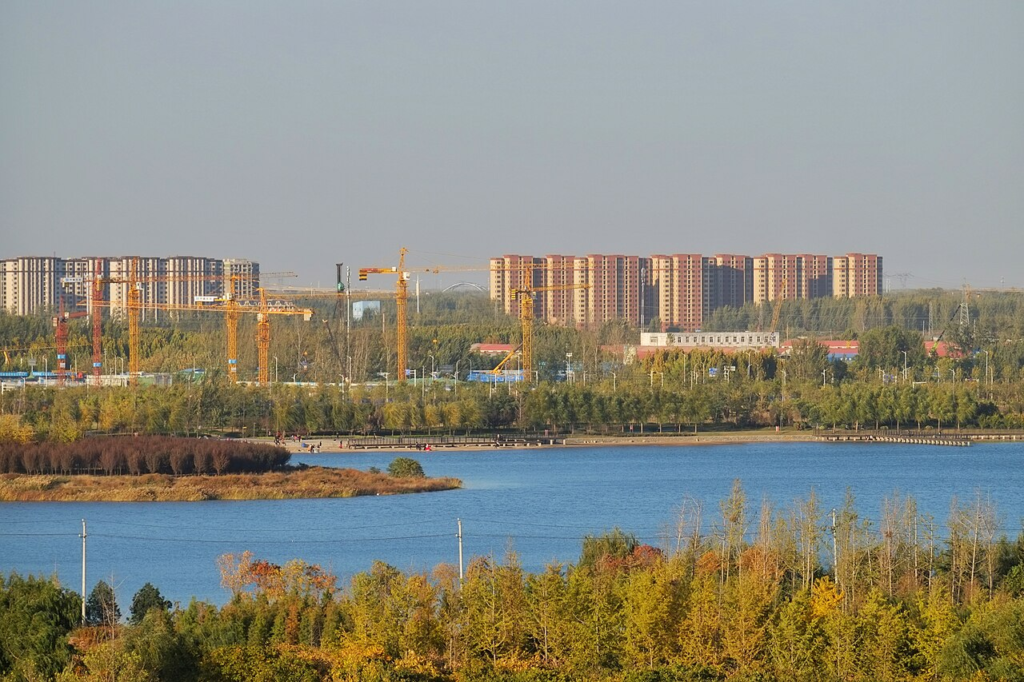
Kangbashi, in Ordos, is a useful case because it exposes the weakness of treating a new district’s identity as permanently fixed by photographs of empty streets.
The peer-reviewed study “‘Ghost city’ or habitable city? The production and transformation of space in China’s new towns” examines Kangbashi through the interaction of government planning, investment and residents’ lived practices. Its central contribution is to connect the production of urban space with the everyday processes through which a place becomes inhabited and habitable. ScienceDirect
This provides a more useful interpretation than either of two familiar extremes. The first assumes that an initially underpopulated district has permanently failed. The second assumes that subsequent occupation validates the original scale and timing of development. Neither conclusion follows automatically.
A district can become more inhabited while still having incurred substantial financial costs. Residents can develop meaningful attachments to a place whose planning remains inconvenient. Conversely, a low level of activity observed during an early development phase does not establish that long-term occupation is impossible.
For researchers, the challenge is temporal. A photograph records a moment; a neighbourhood develops through changing household circumstances, service provision, employment and investment. To evaluate a trajectory, observations need to be repeated over time and interpreted alongside evidence about who lives there and how they use the district.
Research on evaluating urban vitality and identifying possible ghost cities uses emerging geographical data to move beyond anecdotal impressions. Related work on identifying underused neighbourhoods from space shows the range of spatial indicators employed in this field. Such approaches offer evidence about patterns of activity, but their classifications depend on the chosen indicators and thresholds. ScienceDirect
A methodological safeguard follows: low observed activity should prompt investigation rather than serve as a complete diagnosis. Residential occupation, retail performance and public-space use are related but distinct. A functioning residential district may have quiet daytime streets; an illuminated commercial district may reveal little about residential vacancy.
Kangbashi therefore supports a conditional argument. Building ahead of demand can produce places that subsequently become more habitable, but that possibility does not demonstrate that all excess housing will be absorbed. Each district needs evidence about its own changing circumstances.
The most useful assessment would track whether people are staying, whether essential services are accessible and whether maintaining the neighbourhood is financially sustainable. These outcomes provide a stronger basis for judging urban development than its reputation, architectural spectacle or resemblance to an earlier photograph.

The Urban Design Task Is to Make Existing Housing Usable
The practical value of an apartment depends partly on what a household can reach from it. For an oversupplied district, this makes access a central component of housing policy.
The World Bank and Development Research Center’s urbanisation recommendations explicitly support smaller development plots, mixed land uses and stronger links between transport infrastructure and urban centres. Their recommendations also connect household-registration reform with more equal access to services. worldbank.org
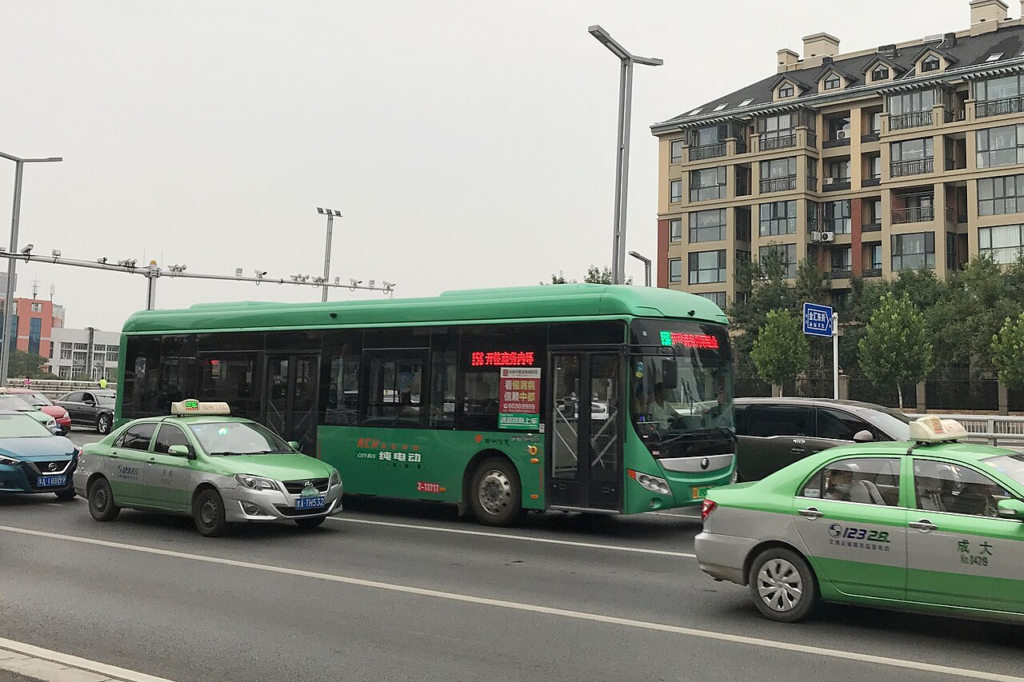
For existing new districts, these principles should be translated into specific questions. Can residents cross major roads safely? Are neighbourhood shops reachable without a car? Does a bus connect housing to actual workplaces at the times employees travel? Can children, older residents and people with disabilities use the same network comfortably?
These questions are more informative than proximity measured only as a straight line. A station may appear close on a map while access requires a long detour around a large development parcel. A school building may be nearby while eligibility, capacity or operating arrangements restrict its usefulness to a particular household.
International evidence offers a relevant comparison, with limits. A World Bank analysis of neighbourhoods around Boston transit stations found associations between residential density, block size, car ownership and travel mode. It supports examining street configuration alongside density. It does not establish that reproducing Boston’s physical characteristics would produce identical outcomes in a Chinese new district. blogs.worldbank.org
The appropriate response is therefore diagnostic and incremental. A district might benefit from additional pedestrian connections, safer crossings, more reliable buses, accessible public facilities or permission for everyday services within residential areas. These are proposed interventions whose effectiveness would need local testing.
Employment requires particular caution. A large planned commercial area is not evidence of jobs available to nearby residents. Before presenting housing as well located, planners should examine the number and types of accessible jobs, wage levels, travel times and the reliability of connections. The objective should be to establish practical compatibility between homes and livelihoods.
Improvements should also follow the distribution of existing residents. Concentrating essential services around occupied clusters can make public spending more useful than distributing identical facilities across a largely unrealised master plan. This does not justify abandoning households in less occupied areas. It requires explicitly assessing how service decisions affect them.
The distinction between physical completion and urban functionality is decisive. A finished development can still require substantial work to become convenient, inclusive and maintainable. Architecture and urban design contribute most when they address those specific barriers rather than assume that additional buildings will generate the missing demand.
Converting Inventory Requires More Than Changing Ownership
Purchasing unsold apartments for affordable housing offers a plausible connection between excess supply and unmet need. However, the existence of both does not mean they match geographically, financially or physically.
China established a policy mechanism for this approach in May 2024, announcing a RMB 300 billion relending facility intended to support local state-owned enterprises purchasing reasonably priced, completed commercial housing for affordable housing provision. This establishes the programme’s original purpose, not its current utilisation or the suitability of every available property. english.www.gov.cn
The IMF’s 2025 Article IV consultation report, published in 2026, described limited traction in government inventory purchases and continuing differences between stronger and oversupplied markets. It also treated protection for buyers of unfinished presold homes as a separate priority. elibrary.imf.org
The planning implication is that acquisition should be evaluated against an operating plan. A public purchaser needs to identify the households the homes will serve, the rent or purchase price they can sustain, and the expenditure required to make the buildings suitable. Acquisition cost alone is an incomplete measure of affordability.
A sound appraisal should include repairs, fit-out, accessibility, building management, utilities, maintenance reserves and service connections. Where rental income will not cover these obligations, the required subsidy should be explicit. Concealing an operating shortfall within a property purchase does not resolve it.
Location is equally important. A discounted apartment may remain unsuitable for a household if it imposes an unaffordable journey to work. Conversely, appropriately located stock may offer substantial social value even when its reuse requires renovation. The decision should compare the complete cost of delivering useful accommodation through acquisition with realistic alternatives.
Ireland provides a limited but instructive comparison. Its unfinished-housing programme assigns local-authority coordinators to assist with development-related problems, while national reporting has tracked progress through development surveys. The 2017 progress report announcement documented a substantial reduction in the number of unfinished developments. These administrative categories are not equivalent to China’s unsold residential floor-area measure. gov.ie
The transferable lesson concerns implementation: identify individual sites, clarify responsibility and monitor resolution. Ireland’s trajectory does not provide a timetable for China, whose scale and institutions differ.
For Chinese new districts, an appropriate programme would distinguish projects needing completion, properties suitable for affordable rental use, occupied neighbourhoods requiring service improvements and speculative extensions that should be deferred. Some buildings may warrant alternative uses, but conversion should follow demonstrated demand and technical assessment. Labelling an apartment block as student accommodation or elderly housing does not establish that it meets those users’ needs.
Success should be measured through sustained occupation, affordability, reliable services and transparent public costs. A transfer from a developer to a public enterprise is only an intermediate transaction. Its urban value depends on what happens afterwards.

Conclusion
China’s large completed housing inventory signals a serious mismatch between construction and realised demand. It does not establish that all new cities are empty, that every vacant apartment is unsold or that every underused district faces permanent decline.
The evidence supports a more discriminating response. Official statistics require careful interpretation; research on Kangbashi demonstrates the importance of examining urban change over time; and institutional assessments emphasise the connections between housing, finance, services and spatial planning.
For new cities, the priority should be to establish which existing places can become more useful and how much that transition will cost. This means protecting households awaiting delivery, assessing suitable stock for affordable occupation, improving everyday access and reconsidering expansion where credible demand is absent.
Some districts may become more inhabited through targeted investment and changing local circumstances. Others may need a smaller development footprint than their original plans anticipated. Neither outcome can be inferred from a national inventory total or a photograph.
The most defensible test of urban success is therefore sustained habitation: whether people can afford to live in a district, reach necessary opportunities and rely on its services over time. Clearing property inventory matters, but creating and maintaining those conditions is the deeper task.
References / Further Reading
- National Bureau of Statistics of China. Investment in Real Estate Development from January to August 2026.
- International Monetary Fund. People’s Republic of China: 2025 Article IV Consultation, Press Release, Staff Report, and Statement by the Executive Director.
- International Monetary Fund. China’s Real Estate Sector: Managing the Medium-Term Slowdown.
- World Bank and Development Research Center of the State Council. Urban China: Toward Efficient, Inclusive, and Sustainable Urbanization.
- “Ghost city” or habitable city? The production and transformation of space in China’s new towns. Cities.
- Evaluating cities’ vitality and identifying ghost cities in China with emerging geographical data. Cities.
- Urbanization that hides in the dark: Spotting China’s “ghost neighborhoods” from space. Landscape and Urban Planning.
- World Bank. Can transit-oriented development change travel behavior in cities?.
- State Council of the People’s Republic of China. China to set up 300-bln-yuan relending facility for government-subsidized housing.
- Government of Ireland. Unfinished Housing Developments.
- Government of Ireland. Publication of the 2017 Annual Progress Report on Actions to Address Unfinished Housing Developments.
Related reading on Urban Design Lab: UN Habitat 2026 Global Housing Crisis and the Future of Housing Policy; Why Bogotá Treats Sustainable Housing as Transport Policy Too