Building the Future: Walter’s Way and Walter Segal’s Vision for Sustainable Housing
Walters Way exemplifies Walter Segal’s innovative, sustainable housing model, blending modular design and self-build principles to foster strong and resilient communities.
The Segal Method
Developed by architect Walter Segal in the 1970s, the “Segal Method” is a system of timber-frame construction designed to be simple enough for non-professionals to build their own homes. It eliminates the need for traditional wet trades like bricklaying and plastering, using standard-sized materials to minimize waste and cost.
Walters Way: A Living Laboratory
Located in Lewisham, South London, Walters Way is a cul-de-sac of 13 unique houses built by the residents themselves in the 1980s. Each house is tailored to the needs of its builders, demonstrating the flexibility and adaptability of the Segal Method. The project was supported by the local council, providing land and training to the self-builders.
Key Principles of the Vision
Empowerment through Self-Build: By involving residents in the construction process, the Segal Method fosters a deep sense of ownership and pride, creating a strong, cohesive community from the outset.
Sustainability and Low Impact: The use of timber and lightweight foundations reduces the environmental footprint of the buildings. The modular design also allows for easy maintenance, repair, and future expansion.
Affordability: By reducing labor costs and using economical materials, the Segal Method makes high-quality, architect-designed housing accessible to people with modest incomes.
Flexibility: The internal layouts of Segal houses can be easily reconfigured as the needs of the residents change over time, ensuring long-term usability and resilience.
Legacy and Influence
Walter Segal’s vision continues to inspire contemporary architects and community groups seeking alternatives to traditional, top-down housing development. Projects like Walters Way serve as powerful examples of how collaborative, sustainable, and resident-led design can address the global housing crisis and create vibrant urban environments.
Conclusion
Walters Way is more than just a collection of houses; it is a testament to the power of community and the enduring relevance of Walter Segal’s principles. As we look toward a future of sustainable urban living, the lessons learned from this unique project provide a valuable roadmap for building more inclusive and resilient cities.
A housing project in Lewisham, South London named Walters Way is a testament to Walter Segal’s approach to self-build and sustainable housing. The project focuses on resident engagement, local materials and modular construction through the use of the Segal Method. In turn, creating strong ties to the community and its economic empowerment as well as its environmental responsibility. Despite the project’s success, issues including long-term sustainability, regulation and scalability need to be addressed for wider implementation. Ultimately it showcases how neighbourhood-driven housing projects can foster strong, supportive communities and encourage environmentally conscious living.
Introduction
Walters Way is an innovative housing project based in Lewisham, South London, is a demonstration of Walter Segal’s groundbreaking approach to sustainable and self-build housing methods. This piece will critically examine the project, exploring its design principles, the roles within the project team and its exciting contribution to the urban environment and community. The cul-de-sac was designed by architect Walter Segal in the 1980s and makes a mark with regards to sustainable urban housing. Segal’s approach, also known as the Segal Method, redefined the construction process by encouraging the notion of self-build techniques. As a result, this made the process of planning, designing and building housing more accessible and participatory for a larger number of people. In essence, democratising housing development.
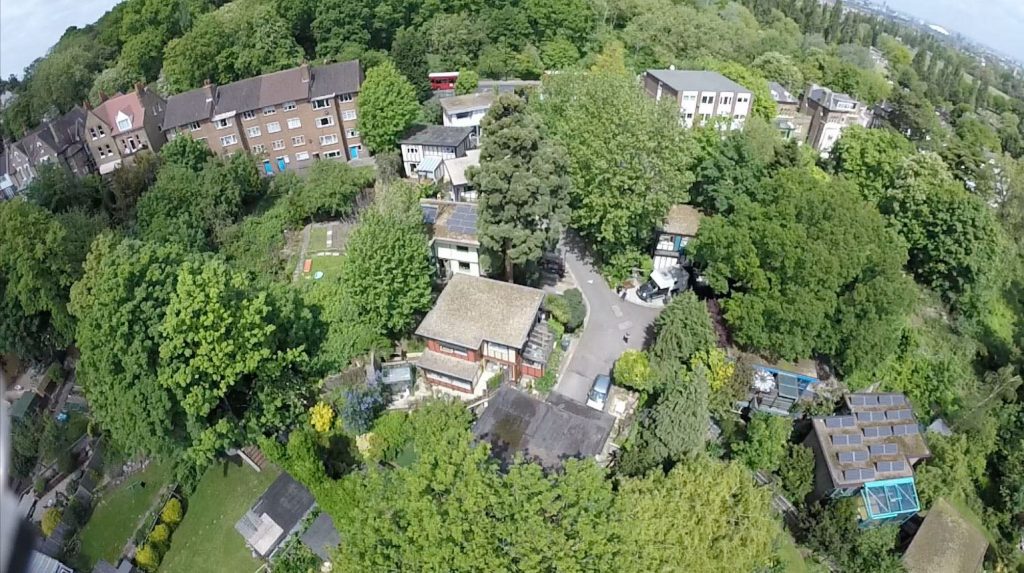
The harmonious cluster of self-built homes, showcasing the nature of the community from an aerial perspective.
The architectural design of Walters Way is rooted in the Segal Method, sustainability, adaptability, and resident involvement underpins the entire scheme. The homes are constructed using a modular framework, allowing for not only easy assembly and disassembly but also for future modifications, ensuring that the houses can accommodate changing family sizes and lifestyles over time. This flexibility enabled residents to create living spaces that precisely meet their needs and preferences, fostering a sense of stewardship and satisfaction. However, in a wider context, implementing this approach could face challenges due to regulatory constraints and financing. Another key element regarding the design of Walters Way is the use of environmentally friendly materials, such as timber and the incorporation of passive design strategies to boost efficiency. The houses were constructed using prefabricated components to minimise waste as well as reduce construction time. This self-build ethos at the heart of Walters Way not only reduced costs but also empowered individuals by giving them a stake in the creation of their homes. In addition, integrating with the natural environment allowed the orientation of the homes to align with optimal ventilation and sunlight, alongside the ongoing incorporation of greenery that enhances biodiversity and fosters communal gathering.
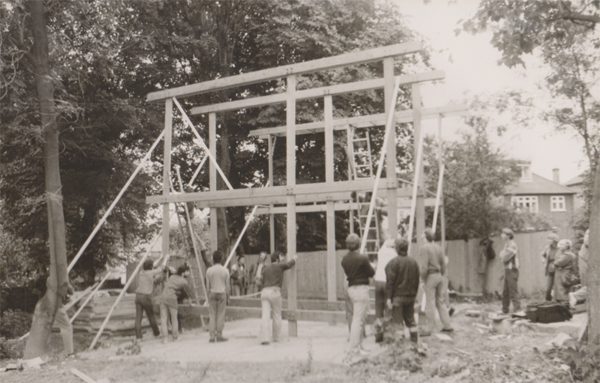
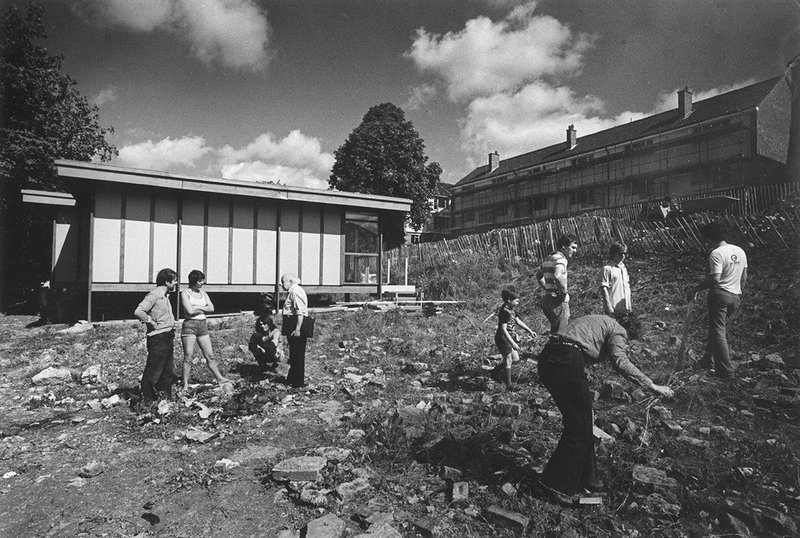
Residents unite in the construction of their homes, embodying the collaborative nature of Walter Segal’s self-build housing model.
Source: Website Link
Contribution to the Community
Walters Way has made significant contributions to the local community and the broader field of urban design, with impacts that can be categorised into social, economic, and environmental aspects. Socially, the self-build approach has cultivated a strong sense of community among residents. The collaborative nature of the construction process has facilitated the blossoming of relationships and support networks, creating a more resilient and cohesive neighbourhood. In essence, it demonstrates the social benefits of participatory housing projects.
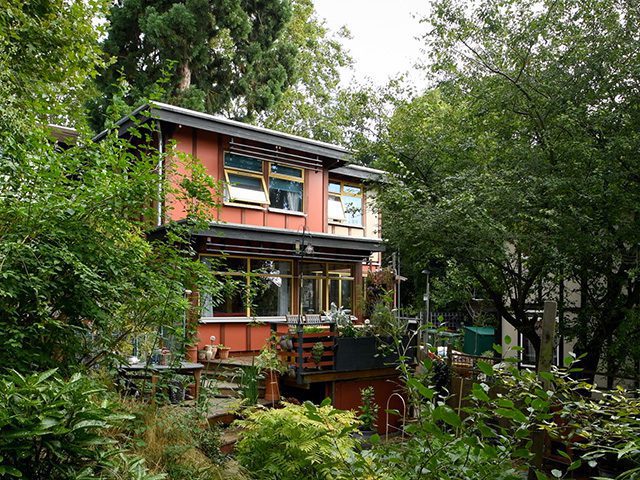
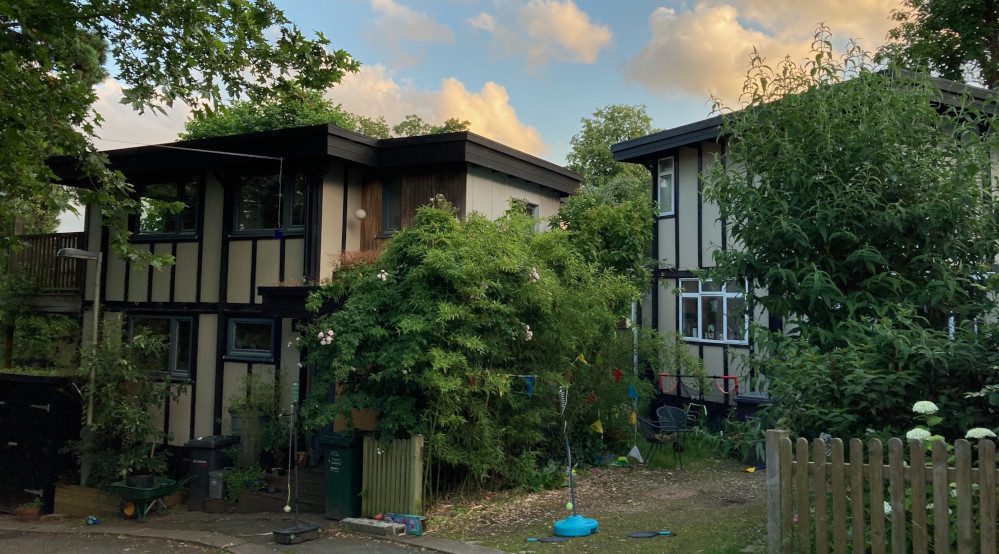
Two homes at Walters Way, showcasing Segal’s sustainable and self-build design principles amidst the greenery.
Economic Empowerment and Environmental Stewardship
About economic impact, Walters Way presents a cost-effective model for housing development. By reducing reliance on traditional construction methods, the project has lowered housing costs. Additionally, the self-build approach has provided residents with valuable skills that can translate into economic opportunities and heightened self-sufficiency. This economic empowerment is such an important aspect of Segal’s vision, highlighting the potential for housing projects to fuel broader social and economic benefits. In terms of environmental impact, the sustainable design and construction technique employed in Walters Way has set a precedent for environmentally responsible urban design. The success of this project will inspire similar initiatives and contribute to the growing recognition of sustainable housing as a viable component of urban planning. By showcasing the feasibility and benefits of sustainable and community-driven housing, Walters Way has played a significant role in furthering the dialogue on environmentally conscious urban development.
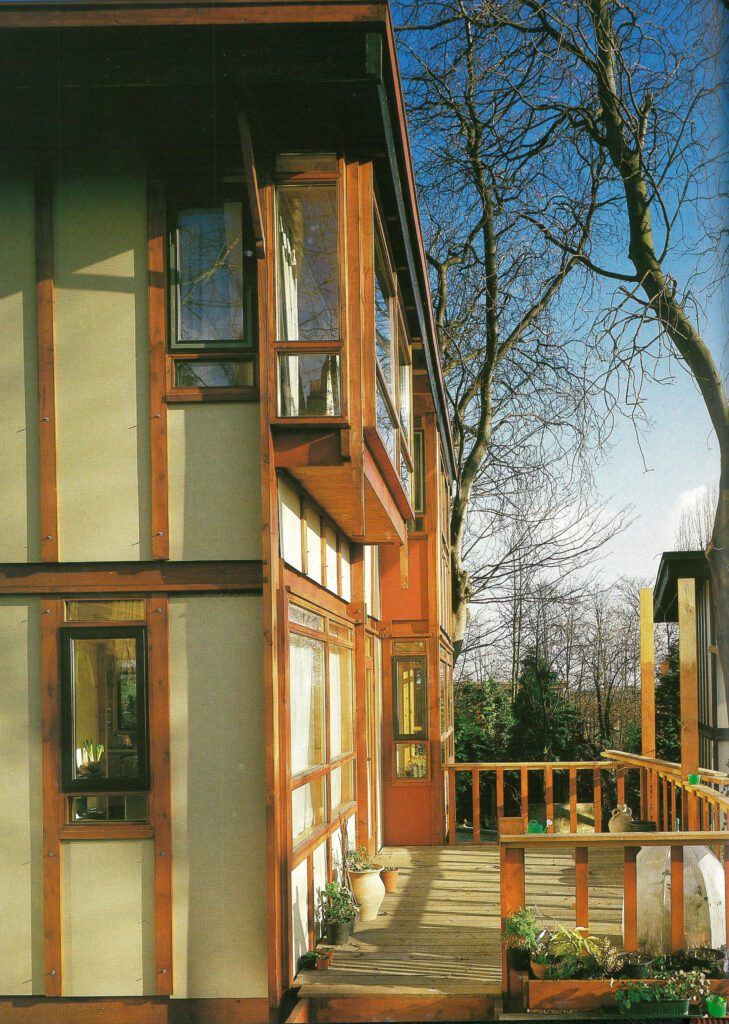
Exterior view showcasing the framework that allows for easy customisation and future expansion.
Despite its success, Walters Way does present challenges and areas for improvement. A notable challenge includes the scalability and replication of the self-build model. Whilst it is highly effective on a smaller scale, the self-build approach requires time and effort from participants, which may not be feasible for larger-scale developments or perhaps in the context where residents merely lack the necessary time, skills or resources. For Segal’s housing concept to be widely adopted, these constraints should be addressed. Replicating the Walters Way concept is further hampered by legislative and policy restrictions. Such projects tend to depend on favourable legislative and policy environments for their success. It could be challenging to undertake these efforts in places where there is a lack of support. The initial actions in eliminating these obstacles are to advocate for legislative reforms and establish frameworks that assist in the development of community-driven housing developments. Another consideration is the idea of ‘long-term sustainability’. Residents must continue to commit to the long-term upkeep of their homes. For these homes to remain successful, it is imperative that future generations are able to maintain and modify them. For residents to preserve these practices, this calls for ongoing education and guidance.
Residents working on site, illustrating the challenges of scalability and the importance of passing down upkeep and skills.
Walter Segal’s idea of community-driven, sustainable housing is exemplified by Walters Way. The strategy, which gives people the freedom to construct their own homes using environmentally friendly materials and techniques, has not only produced inexpensive housing but also strong, resilient communities. Segal’s work is still relevant today as Walters Way taught valuable lessons about sustainable development and planning. But for this housing concept to be widely adopted, it will be necessary to resolve any issues regarding scalability, regulatory backing, and long-term sustainability. Ultimately, Walter’s Way is an inspiring example of what can be achieved when innovative design meets community participation and environmental responsibility.
Metcalf, H. (2020, September 24). Walters Way: take a tour of this iconic street. Grand Designs Magazine. https://www.granddesignsmagazine.com/self-build/walters-way/
Ellis, C. (1987, March). Walter’s Way, self-build schemes, Lewisham, London by the Segal method – The Architectural Review. The Architectural Review. https://www.architectural-review.com/buildings/walters-way-self-build-schemes-lewisham-london-by-the-segal-method
Grahame, A. (2015, September 16). “This isn’t at all like London”: life in Walter Segal’s self-build “anarchist” estate. The Guardian; The Guardian. https://www.theguardian.com/cities/2015/sep/16/anarchism-community-walter-segal-self-build-south-london-estate
The Quietus. (2016, March 19). We Can Build You: Assemble And The Legacy Of Walter Segal | The Quietus. The Quietus. https://thequietus.com/culture/art/aa-self-build-revolution-walter-segal-assemble/
Open House Festival. (2020). Walter’s Way [YouTube Video]. In YouTube. https://www.youtube.com/watch?v=ZmiV5oiPNcs
Burroughs, M. (2018, August 15). The Little-Known Architect Who Helped Londoners Build Their Own Homes. AnOther; AnOther Magazine. https://www.anothermag.com/design-living/11074/the-little-known-architect-who-helped-londoners-build-their-own-homes
Bhairavi Yogasivam
As a designer, Bhairavi centres her work on community-led approaches that cater to user needs. With a Bachelor’s degree in Architecture from Central Saint Martins, she prioritises sustainability and enjoys communicating ideas through playful media, both written and illustrated. Bhairavi enjoys delving into innovative methodologies and theories, with a strong emphasis on shaping urban landscapes and design. In her leisure time, she finds joy in drawing, knitting, and expanding her skills in sewing and stitching.
“Let’s explore the new avenues of Urban environment together “
We use cookies on our website to give you the most relevant experience by remembering your preferences and repeat visits. By clicking “Accept”, you consent to the use of all the cookies. Read More
This website uses cookies to improve your experience while you navigate through the website. Out of these, the cookies that are categorized as necessary are stored on your browser as they are essential for the working of basic functionalities of the website. We also use third-party cookies that help us analyze and understand how you use this website. These cookies will be stored in your browser only with your consent. You also have the option to opt-out of these cookies. But opting out of some of these cookies may affect your browsing experience.
Necessary cookies are absolutely essential for the website to function properly. These cookies ensure basic functionalities and security features of the website, anonymously.
Cookie
Duration
Description
cookielawinfo-checkbox-analytics
11 months
This cookie is set by GDPR Cookie Consent plugin. The cookie is used to store the user consent for the cookies in the category "Analytics".
cookielawinfo-checkbox-functional
11 months
The cookie is set by GDPR cookie consent to record the user consent for the cookies in the category "Functional".
cookielawinfo-checkbox-necessary
11 months
This cookie is set by GDPR Cookie Consent plugin. The cookies is used to store the user consent for the cookies in the category "Necessary".
cookielawinfo-checkbox-others
11 months
This cookie is set by GDPR Cookie Consent plugin. The cookie is used to store the user consent for the cookies in the category "Other.
cookielawinfo-checkbox-performance
11 months
This cookie is set by GDPR Cookie Consent plugin. The cookie is used to store the user consent for the cookies in the category "Performance".
viewed_cookie_policy
11 months
The cookie is set by the GDPR Cookie Consent plugin and is used to store whether or not user has consented to the use of cookies. It does not store any personal data.
Functional cookies help to perform certain functionalities like sharing the content of the website on social media platforms, collect feedbacks, and other third-party features.
Performance cookies are used to understand and analyze the key performance indexes of the website which helps in delivering a better user experience for the visitors.
Analytical cookies are used to understand how visitors interact with the website. These cookies help provide information on metrics the number of visitors, bounce rate, traffic source, etc.
Advertisement cookies are used to provide visitors with relevant ads and marketing campaigns. These cookies track visitors across websites and collect information to provide customized ads.