The best kind of architecture is that which you may not see, but the one you experience. Religion, to most, has been a feeling, a belief, and an experience. Architecture gives these intangibles form; it creates spaces where faith is not only practiced but also sensed. A temple, mosque, cathedral, or shrine does more than house rituals; it choreographs movement, directs sightlines, and evokes emotions that connect the human body to the sacred.
Throughout history, cities have embodied religion through their built forms, turning everyday landscapes into spiritual encounters. To walk through such places is to experience faith made material.
This article examines five cities: Jerusalem, Varanasi, Kyoto, Siem Reap/Angkor, and Mexico City, which frame religion through architecture.
Jerusalem - Stone and Spatial Transitions
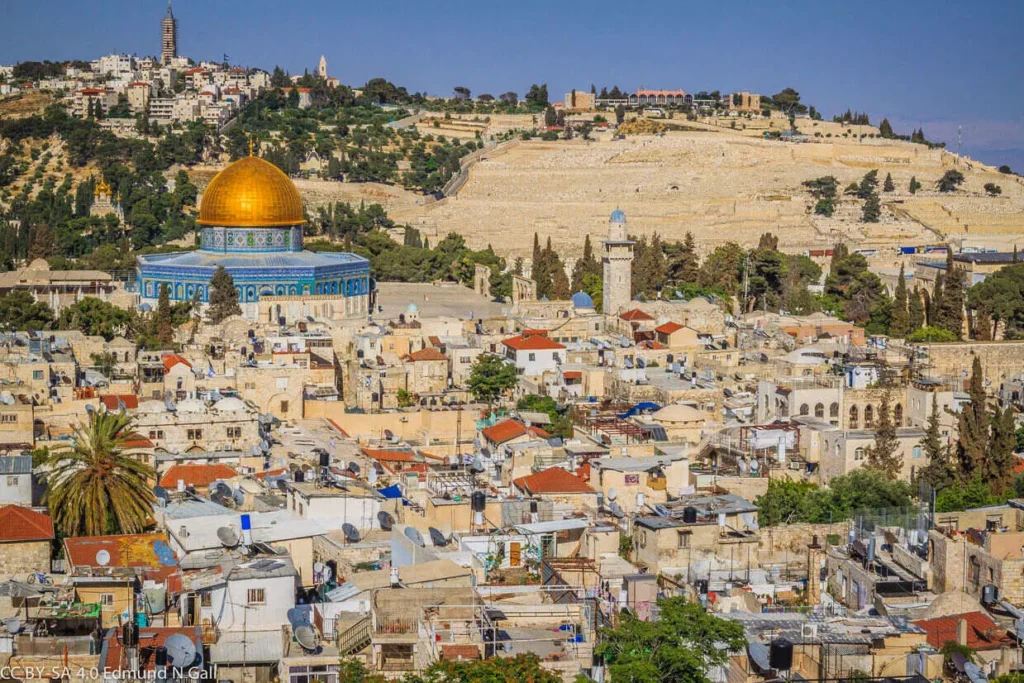
In Jerusalem, religion is made tangible through stone and how spaces guide movement. At the Western Wall, visitors can touch ancient stones, sensing centuries of devotion etched into their rough surfaces (Grabar, 1996). The Dome of the Rock rises above the city, its golden dome reflecting sunlight and acting as a visual landmark. Inside the Church of the Holy Sepulchre, narrow corridors and layered chapels lead pilgrims through the stories of crucifixion, entombment, and resurrection (Weizman, 2007). Even walking through the surrounding streets feels intentional: alleys narrow, open, or bend unexpectedly, subtly guiding focus and pace. Courtyards, gates, and plazas create moments to stop, reflect, and prepare for the next sacred space.
Architecture teaches participation: the way spaces compress before entry, the height of domes overhead, and the feel of stones under fingertips shape perception of devotion. Visitors experience faith through movement and material, sensing layers of history embedded in the city. It is stone and spatial transitions that curate the religious experience in Jerusalem, turning their ordinary paths in and around the city into centuries of religious practice.
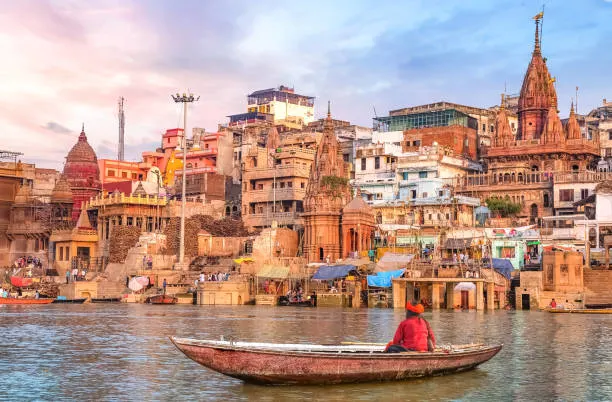
Varanasi channels devotion through terraces and water along the Ganges. The ghats, from Dasaswamedh to Manikarnika, guide movement and attention, turning the riverbank into a stage for ritual (Eck, 2012). Early morning ablutions and evening aarti ceremonies animate the stone steps, while firelight reflects across the water, creating a sensory rhythm. Kashi Vishwanath Temple sits at the end of narrow lanes, where approaching the sanctum through compressed alleys heightens anticipation. Courtyards and temple tanks provide spaces to pause, cleanse, and reflect, structuring ritual as a journey through space. Architecture makes religion accessible: terraces, steps, and platforms guide how one moves, where one stands, and what one sees.
The texture of carved stone, rhythm of steps, and interplay of water and light direct perception, turning ordinary movement into devotion. Even without participating, visitors sense the city’s cosmology. Each ghat, platform, and courtyard orchestrates a dialogue between body and belief. In Varanasi, religion is felt with every footfall, touch, and gaze, as terraces and water choreograph how devotion is practiced and experienced.
Carved stone, steps, terraces and water making the way to experience Varanasi through architecture.
Source: Website Link
Kyoto – Color and Framing
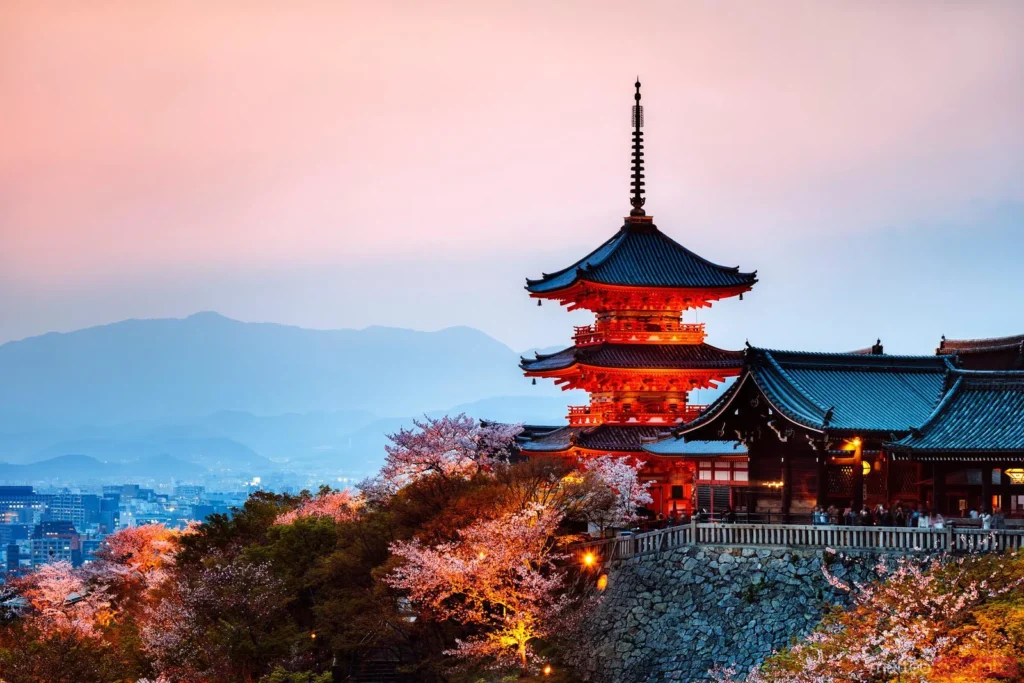
Kyoto communicates faith through color, framing, and sequences that shape movement. Fushimi Inari’s vermilion torii form tunnel-like corridors that guide walking, focusing attention along the path (Smyers, 1999). The repeated red-orange hue draws the eye and organizes motion, transforming walking into a meditative experience. At Kiyomizu-dera, timber platforms project visitors above the valley, framing views and encouraging contemplation. Zen gardens, like Ryoan-ji, offer quiet sequences: sand, stone, and neutral tones compress complex ideas into minimal surfaces (Kuitert, 2002). Gates, courtyards, and small thresholds mark transitions from ordinary to sacred space, signaling pauses for reflection. Smaller shrines use color accents and framed vistas to guide attention and movement. Visitors experience devotion physically: the rhythm of steps, visual repetition, and contrast between open and enclosed areas direct focus.
Architecture acts like a teacher, shaping perception and spiritual engagement. In Kyoto, red torii gates, timber stages, and Zen gardens combine to make religion tangible, allowing visitors to sense faith through sight, movement, and contemplation.
The Kiyomizudera Temple in Kyoto framed perfectly on top of a cliff with red-orange hues.
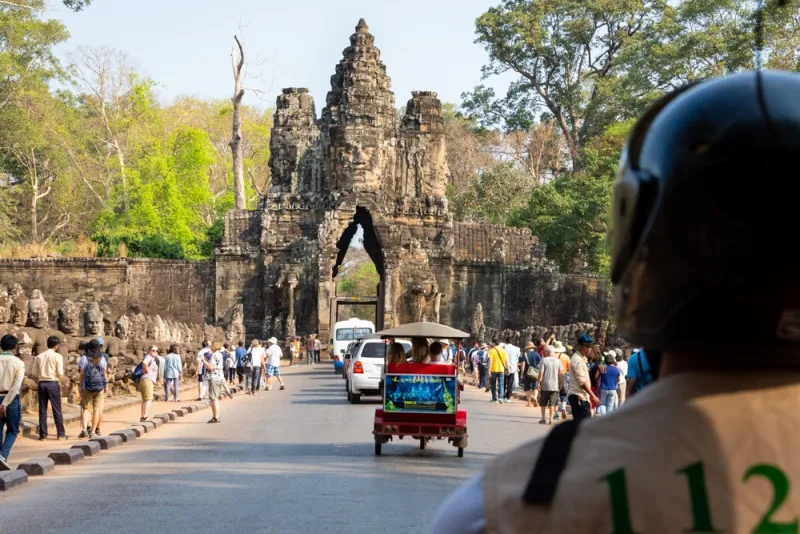
At Angkor, religion is experienced through monumental scale and sculptural relief. Walking along Angkor Wat’s causeway, visitors move across water that mirrors towers, directing focus to the central sanctuary (Evans et al., 2013). Terrace galleries present carved myths, narrating Hindu cosmology visually and tactilely. Angkor Thom’s gates and the Bayon’s massive faces structure orientation, establishing a sense of immersion and presence. Water systems like barays and canals combine functional infrastructure with symbolic meaning, guiding circulation as ritual. Bridges, ramps, and galleries create pathways that manage pace and attention. Light and shadow animate reliefs and surfaces, heightening sensory engagement. Even without formal worship, visitors understand hierarchy, alignment, and cosmology through scale and form.
Monumentality communicates authority and sanctity, while detailed carvings encourage reflection. Angkor’s architecture turns landscape into a medium of faith, where each step, view, and surface conveys sacred narrative. Scale and relief guide movement and attention, making religion tangible and experiential, and demonstrating how architecture alone can communicate devotion.
Road of Siem Reap where scale is guiding movement and attention for the visitors.
Mexico City – Layered Surfaces and Procession Streets
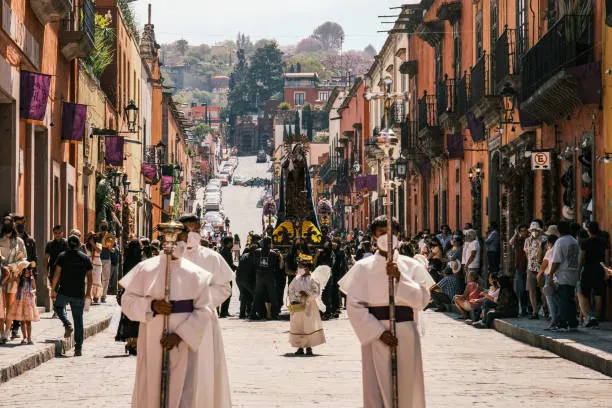
Mexico City expresses faith through the layering of history and the choreography of movement. In the Plaza Mayor, the ruins of the Templo Mayor lie beneath the Metropolitan Cathedral, where Aztec foundations and Catholic ritual merge in a single space (Matos Moctezuma, 2004). Walking here becomes a form of devotion: narrow streets open into plazas, and cathedral interiors (naves, chapels, and portals) draw the eye while slowing the pace of the body.
At the Basilica of Our Lady of Guadalupe, architecture frames the approach to the sacred image. Circular halls, ramps, and platforms manage the flow of pilgrims, while sound and shifting light intensify the atmosphere. Thresholds, steps, and aligned axes serve as subtle cues, encouraging reflection and reverence.
Textures and elevations reinforce hierarchy. Rough stone evokes ancient ritual, polished surfaces denote sanctity, and the climb upward suggests a transition into a higher realm. These spatial gestures turn everyday motion into something ceremonial.
Faith in Mexico City is not confined to monuments but embedded in how one moves between them. Ancient ruins, colonial arches, and modern circulation overlap, creating a continuous processional experience. In this city, walking and pausing are not incidental; they are acts of belief lived across centuries.
The procession of traditional Good Friday Rituals or Semana Santa in the streets of San Miguel de Allende, Mexico.
Religious architecture offers one of the most direct ways to encounter belief without explanation. In 2025, when travel often seeks novelty, cities like Jerusalem, Varanasi, Kyoto, Siem Reap, and Mexico City remind us that spirituality is best understood through space. Their relevance today lies not just in their history but in how they invite both pilgrims and visitors into experiences that feel embodied and immediate.0
Jerusalem sustains three living faiths through sacred landmarks where thresholds carry memory and devotion. Varanasi merges ritual and architecture along the ghats, where steps serve as both public infrastructure and sacred stage (Eck, 2012). Kyoto’s temples and gardens transform proportion and silence into spaces of meditation (Nitschke, 1993). Angkor, even as partial ruins, maps a cosmic order onto the Cambodian landscape (Glaize, 1993). Mexico City layers Aztec foundations with Catholic cathedrals, showing resilience and adaptation across time (Matos Moctezuma, 2004).
Together, these examples affirm that architecture is never passive. It is a living medium through which religions remain visible, experiential, and profoundly human.
Evans, D., Fletcher, R., Pottier, C., Chevance, J.-B., Soutif, D., Tan, B. S., … Chandler, D. (2013). Uncovering archaeological landscapes at Angkor using lidar. Proceedings of the National Academy of Sciences, 110(31), 12595–12600. https://doi.org/10.1073/pnas.1306539110
Weizman, E. (2007). Hollow land: Israel’s architecture of occupation. Verso. [No open link available]
Shubhangi Sharma
About the Author
Curious emerging researcher with a focus on sustainable development, spatial justice, and the everyday life of cities. With a background in architecture, Shubhangi Sharma’s work is grounded in real-world challenges and driven by a belief that design can and should do more.
“Let’s explore the new avenues of Urban environment together “
We use cookies on our website to give you the most relevant experience by remembering your preferences and repeat visits. By clicking “Accept”, you consent to the use of all the cookies. Read More
This website uses cookies to improve your experience while you navigate through the website. Out of these, the cookies that are categorized as necessary are stored on your browser as they are essential for the working of basic functionalities of the website. We also use third-party cookies that help us analyze and understand how you use this website. These cookies will be stored in your browser only with your consent. You also have the option to opt-out of these cookies. But opting out of some of these cookies may affect your browsing experience.
Necessary cookies are absolutely essential for the website to function properly. These cookies ensure basic functionalities and security features of the website, anonymously.
Cookie
Duration
Description
cookielawinfo-checkbox-analytics
11 months
This cookie is set by GDPR Cookie Consent plugin. The cookie is used to store the user consent for the cookies in the category "Analytics".
cookielawinfo-checkbox-functional
11 months
The cookie is set by GDPR cookie consent to record the user consent for the cookies in the category "Functional".
cookielawinfo-checkbox-necessary
11 months
This cookie is set by GDPR Cookie Consent plugin. The cookies is used to store the user consent for the cookies in the category "Necessary".
cookielawinfo-checkbox-others
11 months
This cookie is set by GDPR Cookie Consent plugin. The cookie is used to store the user consent for the cookies in the category "Other.
cookielawinfo-checkbox-performance
11 months
This cookie is set by GDPR Cookie Consent plugin. The cookie is used to store the user consent for the cookies in the category "Performance".
viewed_cookie_policy
11 months
The cookie is set by the GDPR Cookie Consent plugin and is used to store whether or not user has consented to the use of cookies. It does not store any personal data.
Functional cookies help to perform certain functionalities like sharing the content of the website on social media platforms, collect feedbacks, and other third-party features.
Performance cookies are used to understand and analyze the key performance indexes of the website which helps in delivering a better user experience for the visitors.
Analytical cookies are used to understand how visitors interact with the website. These cookies help provide information on metrics the number of visitors, bounce rate, traffic source, etc.
Advertisement cookies are used to provide visitors with relevant ads and marketing campaigns. These cookies track visitors across websites and collect information to provide customized ads.