An evidence-led assessment of BART’s fiscal crisis, ridership recovery and regional policy choices
Introduction
BART is not simply a rail operator facing an uncomfortable budget cycle. It is a regional transport backbone whose financial crisis exposes a deeper weakness in the Bay Area’s urban model: essential public infrastructure has been funded around travel patterns that no longer reliably exist. Before the COVID-19 pandemic, BART’s peak-period, office-oriented role generated high volumes of long-distance commuter trips and substantial fare revenue. Remote and hybrid work disrupted that relationship far more sharply than they disrupted the system’s public purpose.
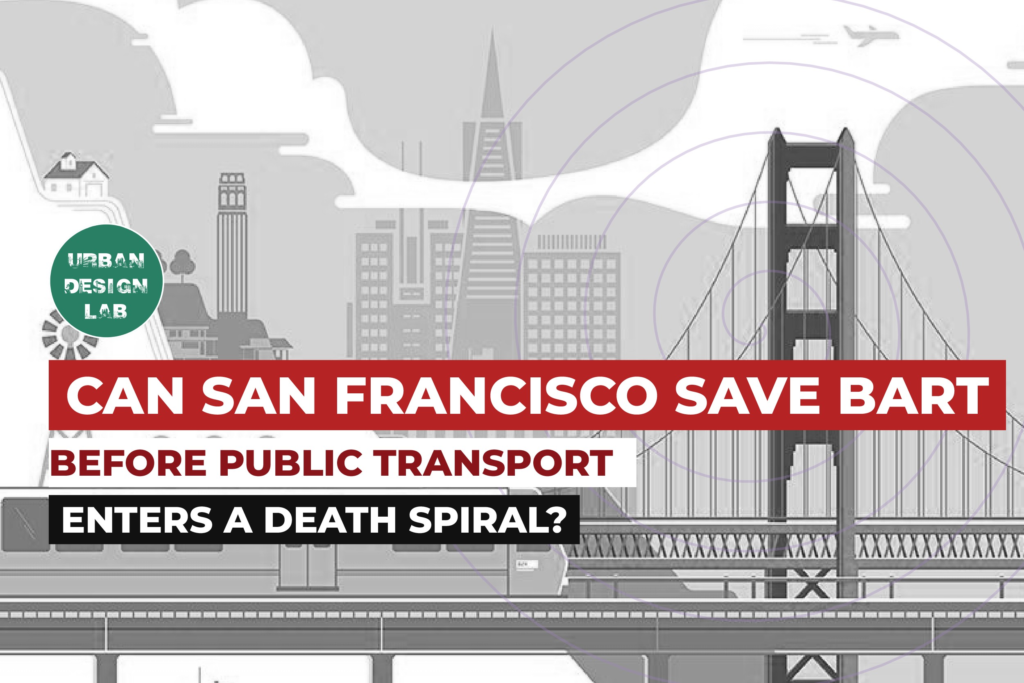
The warning that BART could enter a death spiral should be treated carefully. It does not predict that a rail system will suddenly disappear. It describes a feedback loop: lower ridership reduces fare income, financial shortfalls trigger service cuts or fare increases, the service becomes less useful, and further riders leave. The evidence does not prove that this outcome is inevitable. It does show that BART’s present funding gap is too large to be resolved by incremental patronage growth, fare changes or small administrative efficiencies alone. BART’s March 2026 funding factsheet identifies a projected FY2027 deficit of $376 million and ongoing structural deficits of approximately $375 million to more than $400 million annually.
The question, then, is not whether San Francisco alone can save BART. BART operates across five counties and is embedded in a multi-operator metropolitan network. The more useful question is whether the Bay Area can replace an unstable commuter-fare model with a regionally governed, accountable and rider-centred public transport system before emergency measures erode the network’s usefulness. This article argues that it can, but only if financial stabilisation, service quality, fare integration, land-use policy and institutional reform are pursued together.
The Fiscal Cliff Is Real but It Is Not Only a Cost Problem
BART’s financial position is serious because emergency resources are being exhausted while its pre-pandemic revenue base has not returned. BART states that the pandemic-era emergency funds used to sustain operations run out in 2026. Its FY2027 planning therefore confronts a structural deficit rather than a one-off shortfall. The authority’s alternative scenario without new revenue includes service reductions, station closures, fare increases and other measures needed to balance FY2027 and FY2028 budgets.
This is not evidence that BART has made no effort to contain costs. Between fiscal years 2020 and 2025, BART reports $516 million in operating-cost savings through service reductions, workforce controls and operational efficiencies, alongside $549 million in capital savings. Its FY2027 budget also included $18 million in cuts and reductions in employee headcount. The adopted strategies include shorter trains in lower-demand periods, contract review, parking-revenue measures, fibre leasing and expansion of institutional BayPass participation.
The implication is important. Efficiency matters, especially in a publicly funded system. Yet the scale of the deficit shows that management savings cannot replace a revenue model built around much higher commuter demand. BART’s FY2027 budget notes that annual trips remain around half their pre-pandemic level, even as weekday ridership was projected to rise above 200,000 trips for the first time since the pandemic. A fiscal rescue must therefore distinguish operating support from capital investment. New trains, escalators, train-control systems and station upgrades are necessary to maintain a safe and reliable network, but they do not automatically pay for daily operations. Conversely, balancing the operating budget by deferring renewal can create future reliability costs.
Ridership Has Recovered Unevenly Not Disappeared
The phrase post-pandemic ridership collapse obscures a more complicated reality. BART has not returned to its former commuter volumes, but it is carrying a substantial and growing number of trips. In calendar year 2025, BART recorded 55.6 million trips, up 9.33% from 2024. Average weekday ridership was 180,649, while average Saturday ridership was 108,449. These figures show a system whose demand profile has changed, not a system without demand.
The contrast with the pre-pandemic period remains stark. BART’s 2025 annual report records pre-pandemic average weekday ridership of 412,000. San Francisco’s 2025 Congestion Management Program found that BART ridership in April and May 2025 was 44% of 2019 levels, lower than Muni’s 72% and Caltrain’s 54% recovery in the same comparison. The most defensible interpretation is not that rail has become obsolete. BART was disproportionately exposed to the decline in weekday, office-centred regional travel. Its historic market was precisely the type of journey most affected by hybrid work: long-distance trips into San Francisco’s central business district at fixed morning and evening peaks.
Weekends, events, education, airport-related trips, health-care travel and non-traditional work schedules produce a different temporal pattern. They require all-day frequency, reliable transfers, legible information and safe stations rather than merely restoring an old peak timetable. This distinction has urban-design consequences. Stations connected to housing, education, culture, health care, retail and public space have a broader ridership base than locations that serve principally an office commute. Transit-oriented development is not a quick fiscal cure, but it can diversify future demand.
A Death Spiral Would Be a Regional Economic and Equity Failure
Service cuts may look fiscally rational when viewed narrowly through an individual agency budget. At metropolitan scale, however, they can create costs elsewhere: longer road congestion, reduced access to employment and education, greater household transport expenditure and increased pressure on local bus networks. The public value of BART is therefore larger than the fare revenue collected at its gates.
San Francisco’s 2025 Congestion Management Program demonstrates why the issue cannot be reduced to a simple choice between transit subsidy and user payment. For regional trips to and from San Francisco, transit accounted for 21.9% of person trips. The report also notes that the city’s daily vehicle miles travelled in 2025 remained around 10% below pre-pandemic levels. A severe rail-service contraction could shift trips towards road travel, but the exact scale would depend on fares, parking prices, employment locations, bus alternatives and household access to cars. It should be analysed, not assumed.
The equity stakes are clearer. Transit riders are not a single homogeneous group. BART’s 2025 annual report notes that during the first pandemic year, 75% of passengers served were people of colour. This historical statistic does not establish the current demographic composition of all riders, but it demonstrates why a regionally accessible system cannot be judged only by average farebox recovery. For workers without remote-work options, students, older adults, people with disabilities and households without dependable car access, a loss of frequency or station access can determine whether employment, care and education are reachable. The policy objective should be frequent core service, targeted affordability, universally accessible stations and simple inter-operator transfers.
Safety Cleanliness and Reliability Are Financial Policies Too
Public confidence is often discussed as though it were separate from budgeting. In practice, it is part of revenue policy. Riders decide whether to return to transit based on the complete journey: station environment, fare payment, personal security, service information, wait time, transfer quality and reliability. Revenue measures that ignore this experience risk worsening the very demand problem they are meant to address.
BART’s recent safety measures provide evidence that operational improvements can support recovery. In September 2026, BART reported that crimes against riders per million trips had fallen 67% from the end of 2024 to the latest quarter, while BART Police and safety-related delays had fallen 47% over the same period. The authority also reported that rider sightings of fare evasion had fallen by 60%, with an early estimate of approximately $10 million in annual additional revenue through reduced fare evasion.
These are agency-reported outcomes, not independent causal proof that fare gates alone produced every change. BART describes a package involving new fare gates, visible safety staffing and station hardening. Attribution should remain cautious. Still, the results point to a credible principle: a safer and better-managed station environment can reduce disruption, improve perceived security and strengthen payment compliance. Reliability requires equal attention. BART’s FY2027 capital budget prioritises core infrastructure including train control, traction power and digital systems. A rider who cannot trust the service for a shift start, childcare pickup or flight connection may choose a car even when rail is nominally faster.
Temporary Funding Buys Time Not a Solution
In 2026, California, the Metropolitan Transportation Commission and affected agencies agreed to a $590 million loan intended to avert major service cuts at BART, AC Transit, Caltrain and Muni during FY2026-27. The MTC stated that the four agencies together faced a projected deficit of more than $800 million in the following fiscal year. The agreement is consequential because it prevents immediate service retrenchment while longer-term decisions are made.
It also has limitations. The loan has a 12-year repayment period, with interest-only payments in the first two years and repayment secured by the revenue-based share of State Transit Assistance. It is bridge finance, not recurring operating income. It may prevent a damaging short-term collapse, but future budgets must still absorb repayment and resolve the structural mismatch.
A regional funding measure authorised through California Senate Bill 63 may appear on the November 2026 ballot in Alameda, Contra Costa, San Francisco, San Mateo and Santa Clara counties. According to the MTC, it would establish a temporary 14-year sales tax for transit operations if it qualifies and is approved. Because this is a prospective ballot measure, its passage, revenues and distribution cannot be treated as settled facts. New operating revenue should preserve service, but it should also be matched with transparent performance commitments: reliability, fare compliance, accessibility, station condition, cost per service hour, transfer performance and equity impacts.
What a Credible Rescue Would Look Like
A credible BART rescue has five connected components. First, it needs predictable regional operating finance. Essential rail service cannot depend primarily on fares from a single office-centred travel market. The case for public support should rest on access, congestion management, emissions reduction, labour-market connection and resilience, while still demanding measurable performance from operators.
Second, the region needs coordinated network governance. Riders should not have to understand separate agency boundaries to make a basic trip. Fare capping, seamless payment, timed transfers, unified information and coordinated service planning can make the existing network more useful without requiring every operator to merge institutionally. Third, service planning must reflect changed demand. The goal should not simply be to reproduce the pre-pandemic peak but to build dependable all-day regional mobility. BART’s planned schedule changes, including more evenly spaced services and transfer improvements, illustrate the type of network management that can reduce passenger waiting and transfer penalties.
Fourth, Bay Area jurisdictions should connect land-use policy to transit value. Housing, employment, education, cultural activity and public-realm improvements near stations can diversify demand over the day and week. This is a long-term strategy, not a substitute for immediate funding. Finally, accountability must remain visible. The public should be able to see what additional funding buys: fewer disruptions, faster transfers, safer stations, better access and more reliable service.
Conclusion
BART can be stabilised, but San Francisco cannot do it alone and emergency funding will not be enough. The system’s predicament is rooted in a lasting change to regional travel demand, especially the decline of the traditional office commute. That change has weakened fare revenue without reducing the social and economic necessity of regional public transport.
The evidence supports neither complacency nor fatalism. BART’s ridership is recovering, safety indicators have improved, and the region has secured temporary financing to prevent immediate cuts. Yet the projected FY2027 deficit demonstrates that the old funding model is no longer adequate. The defensible path is a regional compact: stable operating revenue tied to efficiency and public accountability, service designed for present-day travel patterns, integrated fares and transfers, reliable infrastructure, and station areas that generate everyday trips. Without that compact, a death spiral is plausible. With it, the crisis can become an opportunity to build a more resilient metropolitan transport system.
“Let’s explore the new avenues of Urban environment together “
We use cookies on our website to give you the most relevant experience by remembering your preferences and repeat visits. By clicking “Accept”, you consent to the use of all the cookies. Read More
This website uses cookies to improve your experience while you navigate through the website. Out of these, the cookies that are categorized as necessary are stored on your browser as they are essential for the working of basic functionalities of the website. We also use third-party cookies that help us analyze and understand how you use this website. These cookies will be stored in your browser only with your consent. You also have the option to opt-out of these cookies. But opting out of some of these cookies may affect your browsing experience.
Necessary cookies are absolutely essential for the website to function properly. These cookies ensure basic functionalities and security features of the website, anonymously.
Cookie
Duration
Description
cookielawinfo-checkbox-analytics
11 months
This cookie is set by GDPR Cookie Consent plugin. The cookie is used to store the user consent for the cookies in the category "Analytics".
cookielawinfo-checkbox-functional
11 months
The cookie is set by GDPR cookie consent to record the user consent for the cookies in the category "Functional".
cookielawinfo-checkbox-necessary
11 months
This cookie is set by GDPR Cookie Consent plugin. The cookies is used to store the user consent for the cookies in the category "Necessary".
cookielawinfo-checkbox-others
11 months
This cookie is set by GDPR Cookie Consent plugin. The cookie is used to store the user consent for the cookies in the category "Other.
cookielawinfo-checkbox-performance
11 months
This cookie is set by GDPR Cookie Consent plugin. The cookie is used to store the user consent for the cookies in the category "Performance".
viewed_cookie_policy
11 months
The cookie is set by the GDPR Cookie Consent plugin and is used to store whether or not user has consented to the use of cookies. It does not store any personal data.
Functional cookies help to perform certain functionalities like sharing the content of the website on social media platforms, collect feedbacks, and other third-party features.
Performance cookies are used to understand and analyze the key performance indexes of the website which helps in delivering a better user experience for the visitors.
Analytical cookies are used to understand how visitors interact with the website. These cookies help provide information on metrics the number of visitors, bounce rate, traffic source, etc.
Advertisement cookies are used to provide visitors with relevant ads and marketing campaigns. These cookies track visitors across websites and collect information to provide customized ads.