London’s Buses Are Getting Slower: Why “Sustainable Mobility” Is Not Working Automatically

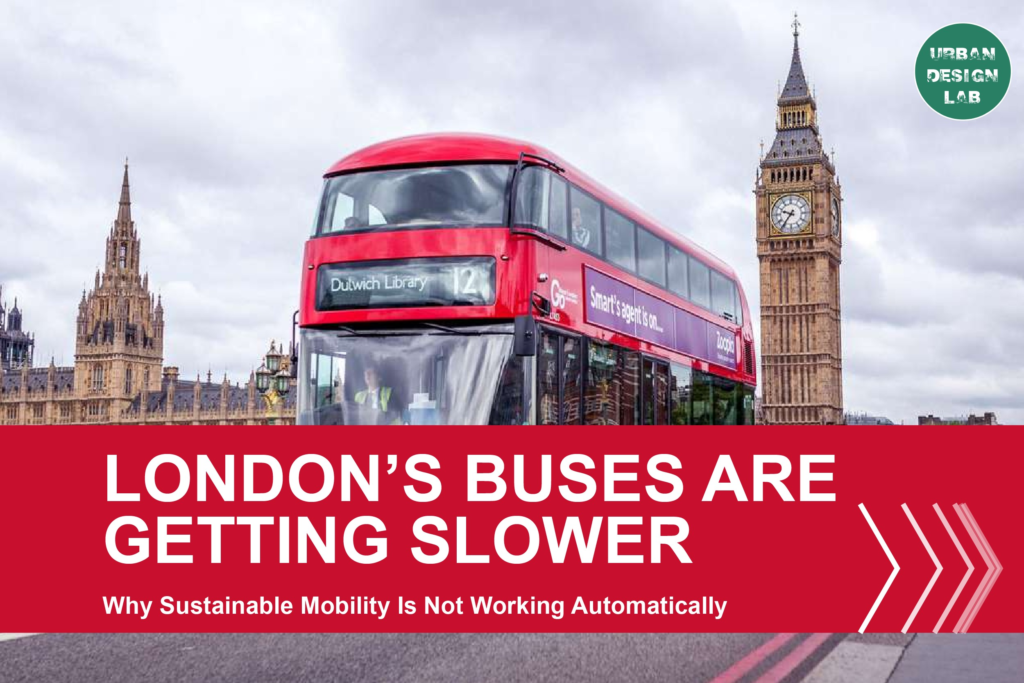
London bus in congested traffic, illustrating falling London bus speeds

A current story with relevance for every city redesigning streets, cycle lanes and bus corridors.

London is routinely positioned as a global reference point for sustainable mobility. It has a large public-transport system, extensive bus coverage, road charging, low-emission regulation, major investments in cycling, pedestrian-oriented street design and an expanding zero-emission bus fleet. These are substantial achievements. Yet one of the most basic measures of transport performance points in the opposite direction: London’s buses are slow, and their speed has not recovered into a sustained improvement.

Transport for London’s 2023/24 annual monitoring reported an average London bus speed of 9.3 mph, a one per cent reduction on the preceding year. TfL identified increasing traffic congestion as a constraint on bus operational performance and reliability. The London Assembly subsequently reported an average network speed of 9.17 mph in 2024/25.

This is not an argument against safer cycling infrastructure, better public realm, lower traffic speeds or walkable streets. Those interventions can improve safety, health, inclusion and environmental quality. Nor does the available citywide evidence establish that cycle lanes are the sole cause of slower buses. Such a conclusion would confuse coincidence with causation. London’s road network is shaped by many interacting pressures: congestion, freight, deliveries, construction, utility works, parking and loading, junction operation, traffic-signal timing, collisions, taxi and ride-hailing activity, and competing demands for limited kerb space.

The more serious issue is institutional and design-related. Sustainable mobility is not produced automatically by reallocating road space. It requires an integrated system in which walking, cycling and public transport are all given practical, continuous and enforceable priority. If a city redesigns its streets but leaves buses exposed to delay at junctions, bottlenecks and kerbsides, it can inadvertently weaken the mode that remains most important for many people who cannot walk long distances, cycle safely, afford taxis or access rail stations conveniently.

London’s bus-speed problem therefore has relevance far beyond the capital. Cities worldwide are redesigning streets around active travel, climate resilience, public realm, liveability and reduced car dependence. The critical question is whether these redesigns make the whole mobility system more effective, or merely change its appearance.

Evidence source: TfL, Travel in London 2024: Annual Overview; London Assembly, Bus Journey Times.

The Evidence: London’s Buses Are Operating Under Sustained Pressure

Buses are central to London’s everyday mobility. They provide dense neighbourhood coverage, serve orbital and cross-town trips poorly served by rail, and remain among the city’s most affordable public-transport modes. They are also crucial for people with limited mobility, shift workers, school and college students, visitors, carers, and households without private cars.

Yet buses operate mainly on streets where they must compete with general traffic. Even where bus lanes exist, their priority can be discontinuous. A lane may end before a signalised junction, be obstructed by loading or parking, or merge into mixed traffic at a bridge, shopping street or roadworks zone. A bus route may gain time over one short section and lose more time at the next bottleneck.

TfL reported that average bus speeds during 2023/24 were 9.3 mph, while noting that bus speeds are increasingly affected by general traffic congestion. The report describes a historical pattern of gradual decline, with an exceptional pandemic-era increase caused by lower traffic levels, followed by a return towards pre-pandemic conditions.

The operational consequences are larger than a single speed statistic suggests. Bus speed affects how many vehicles and drivers are required to maintain a timetable. When a route becomes slower, the operator needs more resource to provide the same frequency. If additional funding is unavailable, passengers may face less frequent service, longer waits, uneven spacing between vehicles and crowding. A small decline in average speed can therefore produce a larger decline in the passenger experience.

TfL itself recognises this relationship. Its bus-priority programme states that quicker journeys can attract passengers and generate operating savings that can be reinvested in improved services, vehicles, stops and shelters. The significance is especially acute because bus passengers are not a socially neutral group. The loss of five or ten minutes may be inconvenient to a traveller with flexible work hours and multiple transport options. For someone making a shift change, school run, medical visit or multi-stop care journey, it can be consequential. Bus performance is therefore an equity issue as much as a technical transport indicator.

Source: TfL 25×25 Bus Priority Programme.

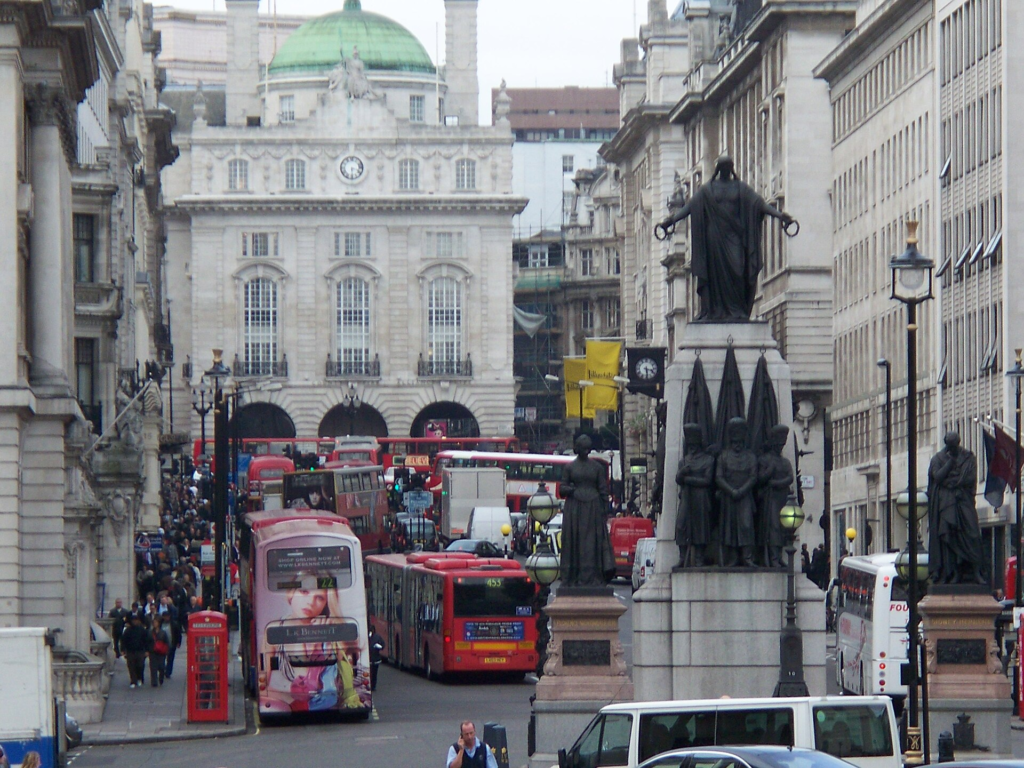
Suggested photograph: London buses operating amid dense central-city traffic at Piccadilly Circus.

Image link: [https://upload.wikimedia.org/wikipedia/commons/d/d7/Buses_at_Piccadilly_Circus.jpg]

Suggested caption: London buses operate within intensely contested central-city streets, where congestion and junction delay directly affect public-transport performance.

Credit: Iridescenti, Buses at Piccadilly Circus, Wikimedia Commons, CC BY-SA 3.0. Include the author name, licence and Wikimedia Commons source page in publication credits.

Why Bus Speed Is a Core Test of Sustainable Mobility

Sustainable mobility is often used as shorthand for a set of desirable physical interventions: protected cycle tracks, widened pavements, street trees, electric vehicles, improved crossings, reduced parking and traffic calming. These measures may be valuable, but they are not sufficient indicators of mobility performance.

A sustainable transport system must enable people to reach employment, education, healthcare, social networks and essential services safely, affordably and reliably. For many urban residents, the bus remains the most realistic low-carbon motorised mode. If bus travel becomes slower or less predictable, the city’s sustainability agenda may become less accessible to the people most dependent on it.

This is particularly important because a street can appear sustainable while imposing a hidden time penalty on bus passengers. A visually improved corridor may include trees, cycle infrastructure, public seating and high-quality paving, while buses still queue behind turning traffic, wait through multiple signal cycles or pull repeatedly into obstructed kerb space. The design may improve the experience of some users but degrade the reliability of another large user group.

This does not mean that buses should receive unquestioned priority in every location. Urban streets must serve pedestrians, cyclists, disabled people, emergency services, freight, servicing and public life. It does mean that trade-offs should be explicit rather than concealed. Where a proposal adds delay to a bus route, planners should identify the scale of delay, the affected passengers, the purpose of the trade-off and the mitigation proposed.

TfL’s 2025 bus-priority guidance adopts this more integrated position. It states that well-designed bus-priority schemes can improve journey times and reliability while considering the needs of people walking, wheeling and cycling. The analytical principle is straightforward: a sustainable-streets scheme should be judged by outcomes rather than visual symbolism.

Source: TfL, Bus Priority Best Practice Design Guidance, November 2025.


  • Has bus journey time improved or worsened by time of day?


  • Has reliability improved, not merely scheduled running time?


  • Are bus passengers protected at the corridor’s main bottlenecks?


  • Has pedestrian safety improved, and is cycling safer and more attractive?


  • Are loading, deliveries and pick-up activity managed without blocking public transport?


  • Has access improved for people who cannot cycle or walk long distances?


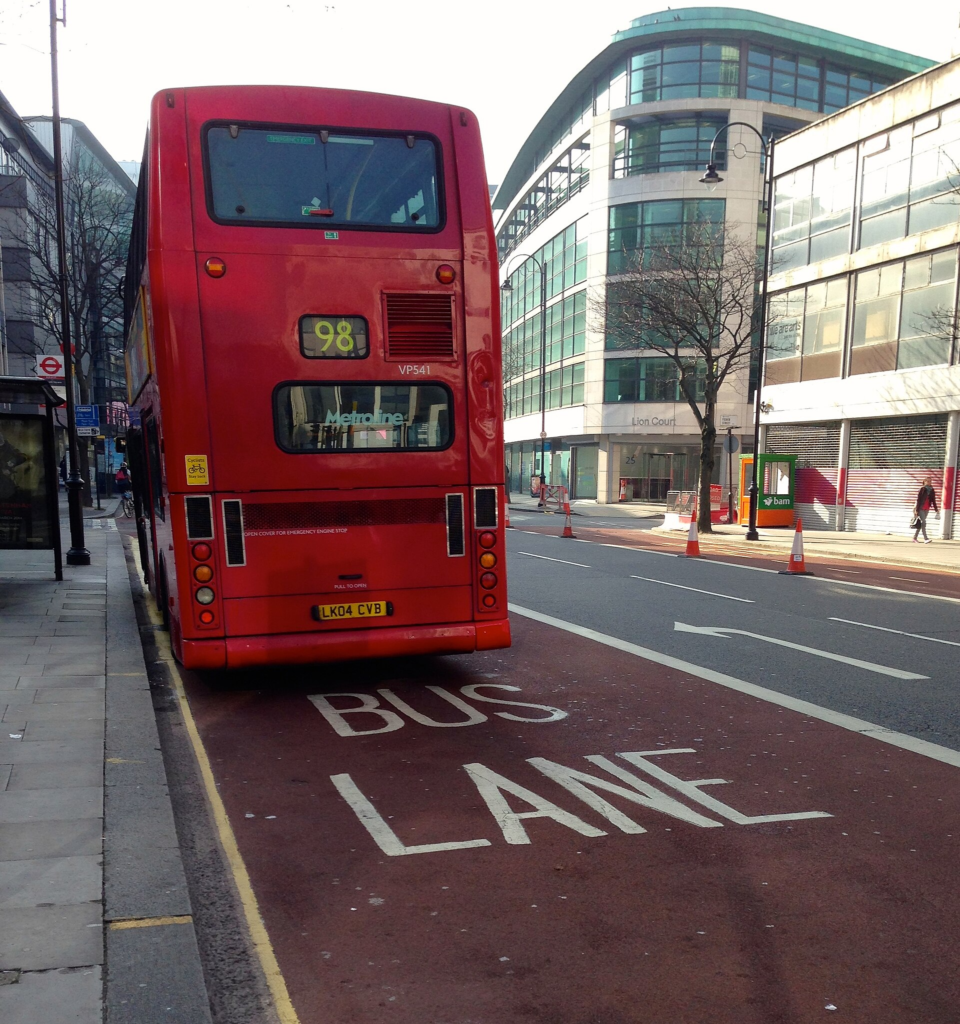
Suggested photograph: A London bus travelling in a clearly marked bus lane.

Image link: [https://upload.wikimedia.org/wikipedia/commons/d/d1/London_bus_in_a_bus_lane.jpg]

Suggested caption: Dedicated bus space can improve performance, but only when priority is continuous, unobstructed and protected at points of delay.

Credit: Use the photographer name and Creative Commons licence listed on the corresponding Wikimedia Commons file page before publication.

The False Binary: Buses Versus Cycling

Public discussion often frames road-space reallocation as a conflict between bus users, cyclists, pedestrians and drivers. This is understandable because urban street space is finite and design changes can produce real inconvenience for particular groups. However, treating buses and cycling as inherently opposed is a poor basis for policy.

Both modes are essential to a lower-carbon transport system. Cycling can replace many short trips, improve health and reduce dependence on private cars. Buses can carry large numbers of people across longer distances, connect dispersed neighbourhoods and provide an accessible alternative where cycling is impractical. The real conflict is usually not buses versus bicycles. It is between high-capacity, low-carbon movement and unmanaged allocation of street and kerb space.

The evidence available for London does not support a simple claim that cycle lanes have caused citywide bus speeds to fall. TfL identifies growing congestion as a key constraint on buses, while road-space outcomes are shaped by multiple interacting variables. A more rigorous assessment would require corridor-specific before-and-after analysis that controls, as far as possible, for changes in traffic levels, construction activity, bus stop locations, signal phasing, route diversions, freight activity, parking controls and service patterns. Without that analysis, claims of direct causality remain assumptions.

Yet it is still possible to identify a legitimate design risk. If a cycle scheme removes mixed-traffic capacity, changes turning arrangements or increases signal phases without a compensating bus-priority strategy, buses may be affected. The response should not be to remove safe cycling provision. It should be to improve the design package: signal priority, bus gates, queue jumps, stop relocation, kerb management, protected bus approaches and restrictions on obstructive turns or loading. The best sustainable corridors do not ask passengers to choose between safe cycling and reliable buses. They design for both.

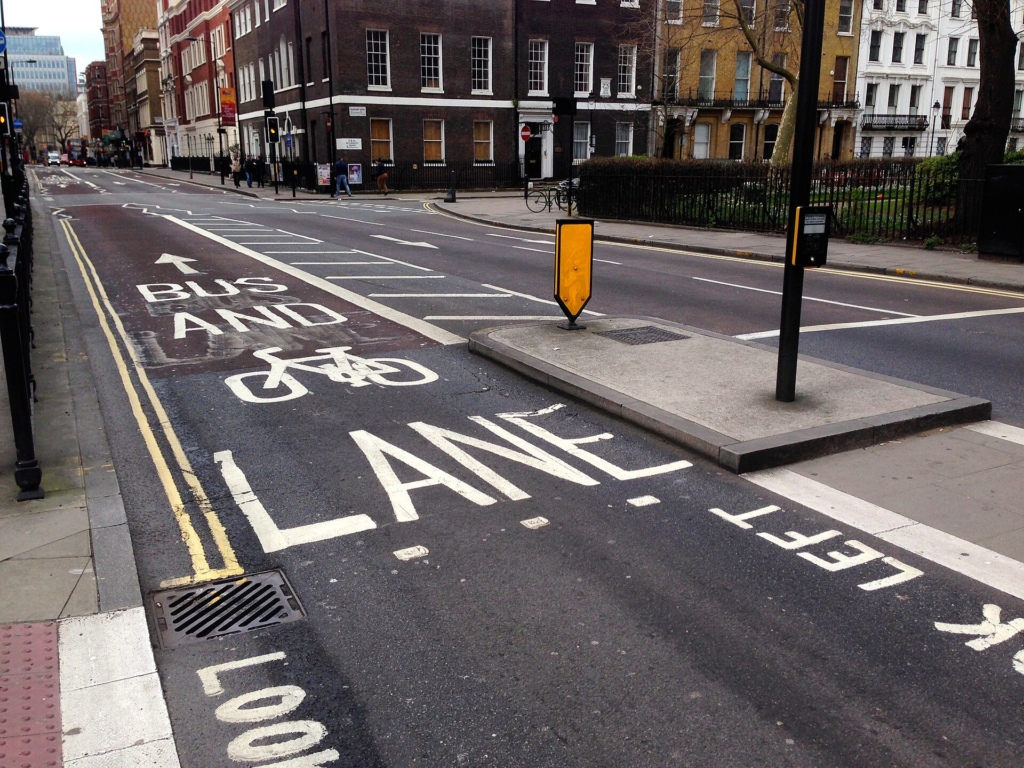
Suggested photograph: A London bus-and-cycle lane illustrating shared low-carbon street space.

Image link: [https://upload.wikimedia.org/wikipedia/commons/b/bd/Contraflow_Bus_and_Bike_Lane_London.jpg]

Suggested caption: Bus and cycle infrastructure can coexist when street space is allocated clearly and movement conflicts are resolved through design.

Credit: Use the creator name and licence stated on the corresponding Wikimedia Commons file page before publication.

Why Junctions, Kerbsides and Enforcement Matter More Than Paint

A bus lane alone does not create bus priority. The most consequential delay often occurs at locations where painted infrastructure is absent or interrupted: signalised junctions, approaches to bridges, narrow retail streets, busy interchanges, loading areas and bus stops.

A bus can move efficiently along a dedicated lane for several hundred metres, then lose its advantage when it reaches a junction with multiple turning movements and long signal cycles. It can be delayed by a delivery vehicle occupying the lane, a taxi waiting at the kerb, a queue of private vehicles turning across its path, or a stop whose position requires difficult re-entry into traffic.

This is why TfL’s design guidance provides a broader toolkit than bus lanes alone. It discusses interventions such as bus gates, bus-only streets, traffic restrictions, signal changes, queue-relocation measures and other context-specific treatments. The importance of continuity cannot be overstated. A bus route is not a collection of separate street segments. It is a single passenger journey. If priority disappears at three major delay points, the benefits of a short lane elsewhere may be negligible.

Kerb management deserves particular attention. The kerb is now a highly contested urban resource. It is used for deliveries, waste collection, taxi pick-up, ride-hailing, disabled parking, restaurant servicing, construction access and micromobility parking. If these functions are not allocated and enforced properly, they can disrupt buses even on streets designed for sustainable movement.


  • Clearly designated and timed loading locations.


  • Bus-stop clearways that are actively enforced.


  • Protected bus-lane sections where obstruction is recurrent.


  • Bus signal priority at delay-prone junctions.


  • Queue jumps where buses need to bypass general traffic.


  • Turning restrictions where turning traffic repeatedly blocks through buses.


  • Stop spacing and boarding layouts that reduce unnecessary dwell time.


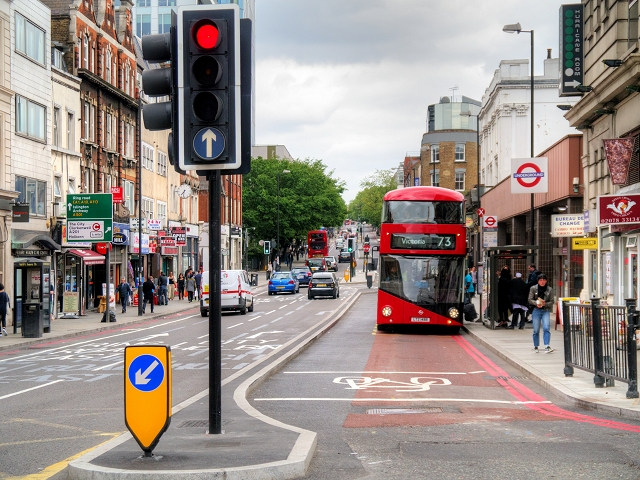
Suggested photograph: A bus lane approaching traffic signals on Pentonville Road, King’s Cross.

Image link: [https://upload.wikimedia.org/wikipedia/commons/d/d5/Pentonville_Road%2C_Bus_Lane_and_Traffic_Lights_at_King%27s_Cross_-_geograph.org.uk_-_4502641.jpg]

Suggested caption: The approach to a signalised junction is often where bus priority succeeds or fails.

Credit: David Dixon, via Geograph and Wikimedia Commons. Use the licence and attribution wording shown on the source file page.

What New York Shows: Bus Improvements Work Best as a Package

New York City provides a useful comparison because it faces many similar conditions: congested roads, high bus dependence, heavy kerbside demand, complex street politics and pressure to improve safety and public space.

Its Select Bus Service programme demonstrates that bus improvement is most effective when it is not treated as a single lane-marking exercise. On Woodhaven and Cross Bay Boulevards, New York City Department of Transportation reported travel-time and reliability improvements of 9 to 10 per cent in the first year after implementation. The intervention combined dedicated bus lanes, off-board fare payment, all-door boarding, median stations, stop consolidation, transit-signal priority and safety improvements.

The same official report recorded a 6 per cent reduction in injury crashes on the corridor, while noting that bus performance improved alongside pedestrian-safety measures. This matters because it challenges the idea that safety and faster public transport are necessarily competing objectives. With appropriate corridor design, they can reinforce each other.

New York’s wider Bus Forward programme similarly set out a combined approach: new and improved bus lanes, transit-signal priority, camera enforcement, all-door boarding and network redesign. The transferable lesson is not that London should copy New York’s street layouts. Different cities have different legal, institutional and urban-form conditions. The lesson is that buses perform better when interventions are bundled and operationally coordinated.

A lane alone may be bypassed, blocked or ended before a bottleneck. Signal priority alone may offer limited benefit if buses remain trapped in general traffic. Stop consolidation alone may improve running time but reduce local accessibility if undertaken without care. Combined measures are more likely to create a meaningful improvement in the passenger journey.

Sources: NYC DOT, Success of Select Bus Service Along Woodhaven and Cross Bay Boulevards; NYC DOT, Bus Forward.

Suggested photograph: A bus-priority corridor with dedicated transit lanes and redesigned median space.

Image link: [https://www.nyc.gov/html/dot/html/pr2018/pr18-059.shtml]

Suggested caption: New York’s Select Bus Service paired dedicated bus infrastructure with boarding reform, signal changes and safety improvements.

Credit: New York City Department of Transportation. Confirm the individual image’s reuse terms before republication.

Designing Sustainable Streets Around Passenger Outcomes

London’s bus-speed problem suggests a stronger framework for evaluating sustainable street design. The starting point should be person-throughput, accessibility, safety and reliability, rather than the visual identity of a project.

First, cities should identify routes where bus priority has the greatest social value. These may include corridors with high passenger volumes, limited rail alternatives, large numbers of older or disabled users, lower-income catchments, hospitals, schools, town centres and major employment areas. Priority should be based on need and impact, not only on whether a lane is easy to install.

Second, cities should measure full-journey performance. A project evaluation should examine bus running time, headway regularity, passenger waiting time, junction delay, dwell time, route reliability, bus-lane obstruction and access to stops. Average network speed is useful, but it is not enough. Passenger experience is shaped by variation and uncertainty as much as by average time.

Third, designers should treat the kerb as essential mobility infrastructure. Freight and servicing are necessary urban activities, but unmanaged kerb use can compromise public transport. Loading bays, delivery windows, enforcement and street-management technology should be planned alongside bus, cycle and pedestrian facilities.

Fourth, projects should be required to demonstrate that bus users will not bear an unexamined penalty. This need not mean that all bus travel-time increases are prohibited. Some safety or public-realm benefits may justify trade-offs. But the effects must be publicly assessed and mitigated, for example through better signal priority, improved frequency, bus gates, stop upgrades or a parallel bus-priority intervention.

Finally, institutional coordination is essential. Public-realm teams, highway engineers, freight planners, borough authorities, bus operators, cycling teams and accessibility specialists cannot work as separate silos. A street is one operating environment, and the passenger experiences it as one journey.

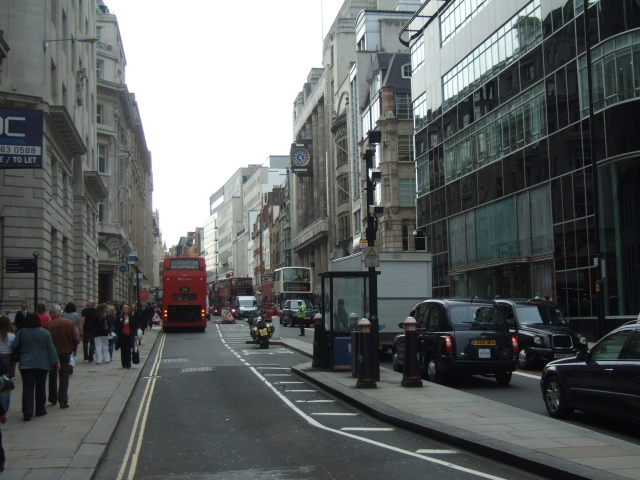
Suggested photograph: Central London congestion showing the interaction of buses, general traffic and constrained street space.

Image link: [https://upload.wikimedia.org/wikipedia/commons/e/e8/Fleet_Street_with_congestion_-_geograph.org.uk_-_1856868.jpg]

Suggested caption: Bus performance depends on how cities manage congestion, loading, traffic signals and the allocation of limited street space.

Credit: David Smith, via Geograph and Wikimedia Commons. Use the licence and attribution wording shown on the source file page.

Conclusion

London’s buses are not slowing because sustainable mobility is inherently unworkable. They are slowing because sustainable mobility requires active operational design, not just the installation of desirable physical infrastructure.

The verified evidence is clear: TfL recorded average bus speeds of 9.3 mph in 2023/24 and identified increasing congestion as a factor affecting performance. London Assembly reporting indicates that network speed remained low in 2024/25. The credible inference is that buses need more continuous, enforceable and corridor-wide priority if they are to remain competitive.

The incorrect interpretation would be to treat cycling infrastructure, pedestrian improvements or lower speed limits as inherently hostile to bus passengers. The stronger interpretation is that cities must stop designing these modes in isolation. A sustainable street is not one that simply looks greener or contains more modes. It is one that improves the actual ability of diverse people to travel safely, affordably and reliably.

For cities redesigning streets, the decisive question is practical: after the project opens, does the person who depends on the bus have a better journey than before? If the answer is no, the project may still contain valuable environmental or public-realm elements, but it has not yet achieved integrated sustainable mobility.

Suggested photograph: London buses moving through a central-city traffic environment.

Image link: [https://upload.wikimedia.org/wikipedia/commons/d/d7/Buses_at_Piccadilly_Circus.jpg]

Suggested caption: The future of sustainable mobility depends on making public transport not only cleaner, but faster and more reliable in everyday conditions.

Credit: Iridescenti, Buses at Piccadilly Circus, Wikimedia Commons, CC BY-SA 3.0.

References and Further Reading

Related reading on Urban Design Lab: Top 10 Bicycle Infrastructure Case Studies; Designing the Last Mile Delivery Lane to Save Urban Streets

Leave a Reply

Your email address will not be published. Required fields are marked *

This site uses Akismet to reduce spam. Learn how your comment data is processed.

Related articles

UDL Thesis Publication 2025

Call for Abstracts now open!

UDL GIS

MASTERCLASS

Urban Mapping, Analysis and Representation

Session Dates

12th-16th October, 2026

Curating the best graduate thesis projects globally!

Publish your work and get recognized globally!

Free E-Book

From thesis to Portfolio

A Guide to Convert Academic Work into a Professional Portfolio”

Urban Design Lab

Be the part of our Network

  • Stay updated on workshops, design tools, and calls for collaboration

  • Thesis Report Writing for Architecture and Urban Studies

    Join Our WhatsApp Group

    Recent Posts

    Sign up for our Newsletter

    “Let’s explore the new avenues of Urban environment together “

    E-Book- From Thesis To Portfolio

    A Guide to Convert Academic Work into a Professional Portfolio